
Content by Matt Pavia, Licensed CT Precious Metals Dealer & ANA Member
Published September 21, 2026 · Last reviewed September 21, 2026 · 7 min read
What is a Kennedy Half Dollar?
The Kennedy half dollar is one of the few U.S. coins born out of grief. After President John F. Kennedy's assassination in November 1963, Congress moved quickly to honor him, and within months the Mint had a new half dollar ready. It featured Kennedy's profile on the obverse and a heraldic eagle on the reverse. It was one of the fastest design changes in the history of U.S. coinage, authorized at the end of December 1963 and in circulation by March 1964.
That emotional weight made the coin an instant sensation. People hoarded the first releases almost immediately, tucking them away as keepsakes rather than spending them. It's certainly part of why so many early Kennedy halves survive today in excellent condition. Decades later, it's still being minted, but its composition and purpose have shifted a bit since that first run in 1964. For a beginner, the Kennedy half dollar is a great entry point into coin collecting, since it connects real American history to a coin you might still find in a piggy bank.
When Were Kennedy Half Dollars Made?
The Kennedy half dollar debuted in 1964 and has been struck every year since, making it one of the longest continuously produced coin designs in U.S. history. It circulated as ordinary pocket change through the 1960s and 70s. As the years went on, half dollars became less common in everyday transactions, and the Mint gradually shifted toward producing them mainly for collectors rather than commerce.
This long production run also means the coin has lived through several major changes in U.S. coinage, most notably the country's move away from silver coinage in the mid-1960s. Because of that, the year on a Kennedy half dollar is often the first pointer to what the coin is actually made of and the starting point for figuring out what it's worth.
Which Kennedy Half Dollars Contain Silver?
Silver content in the Kennedy half dollar is a three part story. The 1964 issue, the coin's debut, was struck in 90% silver. This was the same standard used across U.S. silver coinage before 1965. As silver prices climbed and the government phased silver out of circulating coinage, 1965 through 1970 half dollars were instead struck in a 40% silver clad composition.
From 1971 onward, the Kennedy half dollar removed all silver, switching to the same copper-nickel clad composition used in dimes and quarters today. There are two exceptions collectors should know about. The 1776–1976 Bicentennial half dollar was also struck in a 40% silver version with an "S" mint mark for collector sets, and those turn up in family coin jars more often than people expect. And the Mint's annual silver proof sets have included specially struck 90% or .999 fine silver half dollars in most years since 1992.
How Much Silver Is in a 1964 Kennedy Half Dollar?
A 1964 Kennedy half dollar weighs 12.5 grams and is struck from 90% silver, the same coin silver standard used across the nation's circulating silver coinage right up until the switch in 1965. Work out the math and it's roughly 0.3617 troy ounces of pure silver in every single 1964 half dollar.
Because every 1964 half dollar shares this exact composition, no matter the mint, calculating a rough baseline value is simple: multiply 0.3617 by the current spot price of silver. That gives you the coin's general silver value before factoring in any condition or collector premium.
How Much Silver is in a 1965-1970 Kennedy Half Dollar?
Half dollars struck between 1965 and 1970 are a bit of a hybrid. Rather than being solid 90% silver like the 1964 issue, they're silver clad, meaning outer layers of 80% silver were bonded to an inner core with a lower silver content. The average comes out to 40% silver overall across the coin's 11.5 gram weight. That's approximately 0.1479 troy ounces of pure, real silver per coin, although much less than the 1964 issue.
This transitional composition exists because the government was trying to stretch the country's silver supply while phasing it out of coinage gradually. As with the 1964 issue, you can calculate a rough baseline value by multiplying 0.1479 by the spot price. For readers sorting through old family coin jars, these transitional-year halves are often hiding in plain sight among coins people assume are ordinary pocket change.
What is a 1964 Kennedy Half Dollar Worth?
The 1964 Kennedy half dollar's value starts with its silver content: 0.3617 troy ounces, multiplied by whatever silver is trading for, which gives you the coin's silver value. Don't forget about the potential extra value in condition, though.
Well preserved uncirculated examples, especially ones that were tucked away and never circulated, tend to command more interest than heavily worn coins, since so many people saved this particular year as a keepsake. A handful of 1964 halves also exist in Special Mint Set format, a scarce and unusual variety, but the chances of finding one are slim to none. But, as always, condition and whether a coin is an unusual variety matters just as much as the silver underneath it.
What is a 40% Silver Kennedy Half Dollar Worth?
A 40% silver Kennedy half dollar, meaning any coin dated 1965 through 1970, starts its value calculation with 0.1479 troy ounces of silver, multiplied by the current spot price. That silver baseline is smaller than the 1964 issue's, reflecting the lower silver content in this composition.
Circulated examples from these years are common enough that most trade close to that silver floor, since mintages were sky high. Uncirculated examples in clean condition, and certain dates within this range like the scarcer 1970-D, garner some collector demand on top of their silver content. It's worth checking the specific date before assuming any 40% silver half is priced the same as the rest.
What Will a Dealer Actually Pay for Kennedy Half Dollars?
Here's the part most people reading this actually want, and it depends almost entirely on the date. 1964 halves are the easy ones: they're 90% silver, refiners and other dealers want them, and a fair offer on circulated examples is right at their silver value, 0.3617 ounces times spot, sometimes a shade under when you're selling a large quantity. They're priced by weight as a group, not coin by coin, unless one is uncirculated or a recognized variety like the "Accented Hair" 1964 proof, in which case it's pulled out and priced on its own.
The 40% halves from 1965 to 1970 surprise people. Because the silver is bonded to a copper core, they cost more to refine and fewer buyers want them, so they usually trade at a discount to their melt value, often noticeably under the number you'd get from 0.1479 times spot. A dealer who offers a little under melt on a jar of 40% halves isn't shorting you; that's the market for them. The 1970-D, the 1976-S 40% silver Bicentennial, and the silver proof halves from 1992 onward are the exceptions and get priced individually.
Anything dated 1971 or later with no "S" silver proof pedigree is clad, and no dealer pays more than face value for it unless it's a specific low-mintage date in uncirculated condition or still in its Mint packaging. When we evaluate Kennedy halves, we sort them into those groups in front of you, weigh the silver groups on the scale, and show you the spot price we're working from, so you can see why a 1964 roll and a 1968 roll came back with very different numbers.
Licensed Connecticut Dealer • Insured through Lloyd's of London • Free Evaluations • Same-Day Payment
Bring the whole jar to 2285 Whitney Ave, Hamden — we sort by year, weigh the silver in front of you, and show you the math.
Book Free AppointmentOr call (203) 717-4921
Are Kennedy Half Dollars After 1971 Worth Anything?
Starting in 1971, the Kennedy half dollar switched to a boring, generic copper-nickel clad composition with no silver at all, the same material used in circulating dimes and quarters today. That means a post-1971 Kennedy half dollar has no meaningful metal value beyond its face value of fifty cents, since there's no precious metal.
That doesn't mean every post-1971 half is worthless to a collector, though. Certain low-mintage years, special finishes from Mint sets, and coins in exceptional condition can carry a modest premium over face value for collectors building a complete date set. But if you're sorting old change specifically hoping to find silver coinage, a Kennedy half dated 1971 or later is one you can generally ignore, with the 1976-S silver Bicentennial as the lone exception. The real treasure hunt with this series lives in the earlier 1964 to 1970 window.
Which Kennedy Half Dollar Dates Are Valuable?
A few dates rise above the group. The 1970-D stands out as the most talked-about key date in the entire series. It was never released into general circulation, appearing only in that year's Mint sets, and its relatively low mintage has made it a favorite among collectors chasing the 40% silver era. It generally brings a solid premium over its silver value, several times what a common 40% half is worth.
Even more remarkable is the 1964 Special Mint Set half dollar, an extraordinarily rare variety struck with unusual care and precision, but only a small handful are known to exist today. Examples have sold at auction for well over $100,000, but the chances of actually finding one are sadly near zero. Beyond these big dates, certain low-mintage proof and Special Mint Set issues from the 1990s and 2000s also draw steady collector interest, so it's always worth checking a specific date with a current collector reference before assuming a coin is common.
Where is the Mint Mark on a Kennedy Half Dollar?
The mint mark's location on a Kennedy half dollar actually depends on the year. On coins struck in 1964 the mint mark appears on the reverse, below the eagle's left talon, just beside the olive branch. From 1965 to 1967, mint marks were purposefully left off to prevent hoarding. Starting in 1968, the Mint moved the mint mark to the obverse, where it now sits just above the date, below Kennedy's neck.
Wherever it's located, the mint mark itself works the same way across the series: no mark means Philadelphia, "D" means Denver, and "S" means San Francisco. A magnifying glass or coin loupe helps here, since the mark is small and can wear down on heavily circulated examples.
How Do You Sell Kennedy Half Dollars?
Selling Kennedy half dollars starts with sorting by year, since a 1964 issue, a 1965-1970 transitional coin, and a post-1971 coin are worth very different amounts. For any silver coin, calculate a rough baseline using the live spot price (Kitco.com/silver is the one we use), and set aside anything dated 1970 or earlier that looks unusually well preserved.
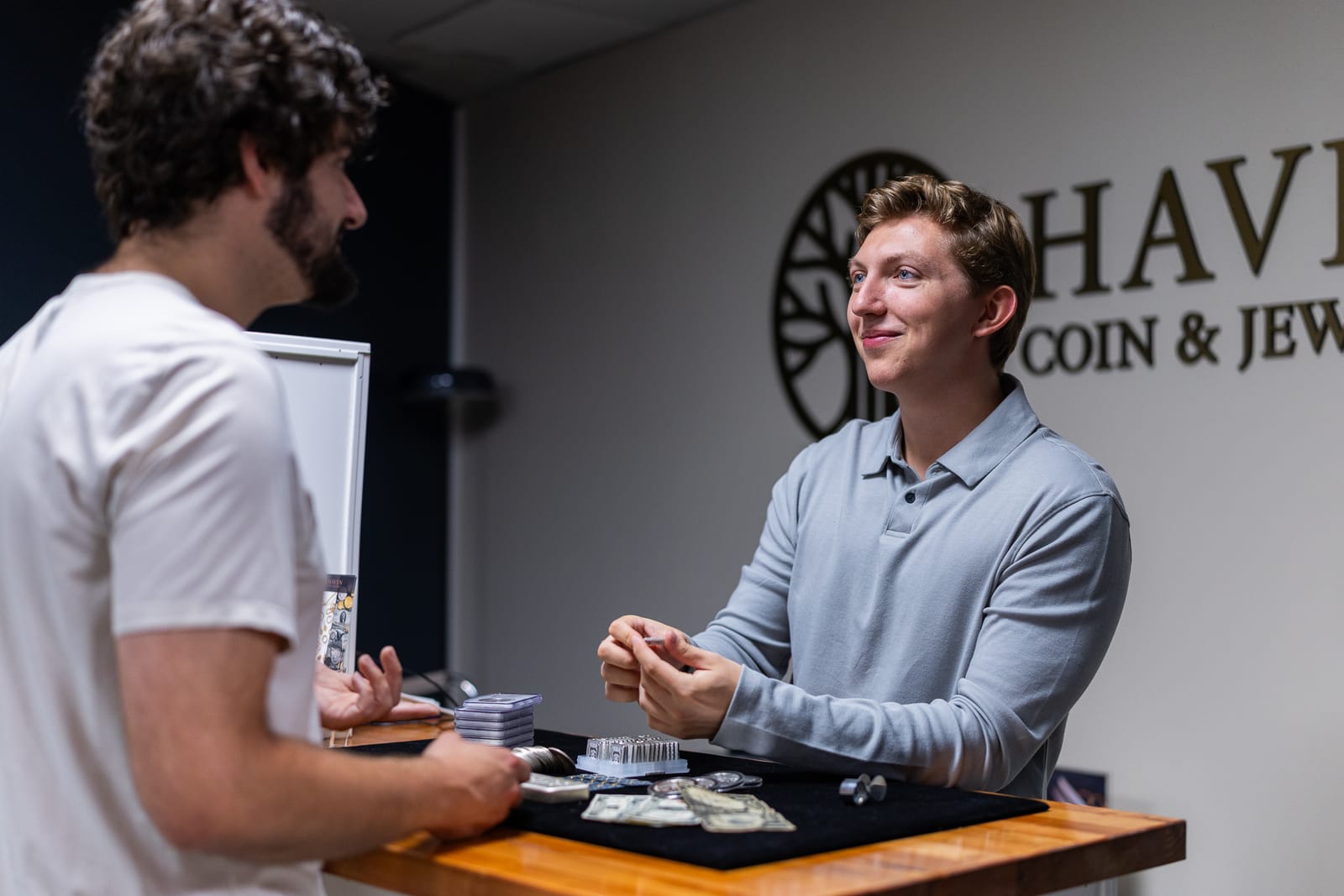
If you're in or around Hamden, Connecticut, stop by Haven Coin & Jewelry for a free, no-obligation evaluation. Walk-ins are welcome during business hours (Tuesday through Friday 10am–5pm and Saturday 10am–2pm), or give us a call to schedule a time for a larger collection. We'll sort and weigh everything right in front of you, price it against live market prices with the math shown, and pay you by check on the spot, as Connecticut law requires. When you're ready to sell, you can reach us at (203) 717-4921, or find us at 2285 Whitney Ave, Hamden, CT 06518.
FAQ: Kennedy Half Dollars
Are Kennedy half dollars silver?
Only certain years: 1964 issues are 90% silver, 1965 through 1970 are 40% silver, and anything from 1971 onward contains no silver, apart from the 1976-S Bicentennial silver version and the silver proofs sold in Mint sets since 1992.
How much is a 1964 half dollar worth?
Usually its silver content, about 0.3617 troy ounces, multiplied by the current spot price of silver. Uncirculated coins and the Accented Hair proof variety can bring more.
What Kennedy half dollars are rare?
For standard strikes, the 1970-D is the best-known key date of the series and carries a real premium over its silver content. The 1964 Special Mint Set half is the true rarity, with only a handful known.
Where can I sell Kennedy half dollars?
Local coin and bullion dealers, precious metals exchanges, and reputable online buyers all purchase Kennedy half dollars.

Written by
Matt Pavia
Founder & Owner, Haven Coin & Jewelry
Matt Pavia is a licensed Connecticut precious metals dealer, ANA member, and GIA-trained appraiser with 8 years of experience buying coins, gold, and jewelry. He founded Haven Coin & Jewelry in Hamden, CT in 2025 and is insured through Lloyd's of London.
About Matt & Haven Coin →Ready to get a professional evaluation? Visit us at 2285 Whitney Ave, Hamden CT or call (203) 717-4921.
Book Free Appointment