
Make Room for the Jewelry Questions in a House Settlement
A Portland family home can leave its next generation with objects whose everyday names tell only part of the story. The wedding band, school ring, and chain remembered as Scandinavian gold may differ in purity, construction, and condition. Keep each piece with the records that belong to it instead of assuming the entire jewelry box represents one grade of gold.
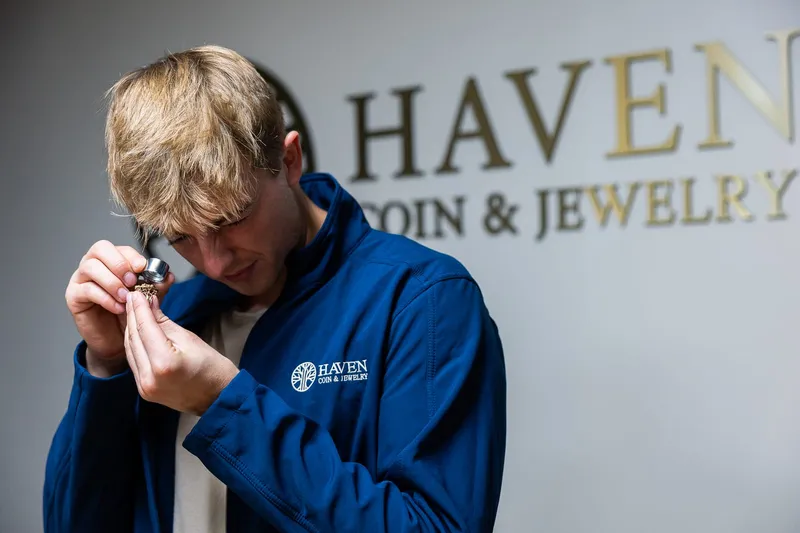
For households along Main Street and in Gildersleeve, the nearby Middletown buying options are convenient and reasonable to compare. Haven offers a specific process for the trip to Hamden: visible testing and weighing, an explanation of mixed components, and a written purchase proposal. We are a buying business, so the conversation concerns your objects rather than what you might purchase from us.
Before leaving Portland, choose the pieces the family intends to keep and discuss who can authorize a sale. If the group includes sterling flatware or several watches, mention that when scheduling. Photos of the complete group and legible marks help us reserve enough time. The appointment can then address questions about the material and value instead of becoming a hurried decision about family keepsakes.

Build the Offer from Identified Material
Wedding sets, class rings, and karat differences
A 14k wedding band and an 18k chain do not contain the same proportion of gold. We test the items and identify the relevant weight rather than assume a jewelry box has a uniform purity. A class ring may include a stone or other components that affect how the calculation is made. Ask what has been counted and what has been excluded. A readable mark is useful evidence, but the condition and actual construction still need examination.
Scandinavian marks and inherited jewelry
Jewelry described by a relative as Scandinavian may carry marks that are unfamiliar to its current owner. Bring any paperwork and keep matching pieces together. An 18k or 750 indication points to a nominal gold proportion, but origin alone does not establish purity, age, or collectible demand. We consider the intact piece, including maker and condition where identifiable, before explaining whether something beyond metal influences the proposed purchase. The family account provides context without replacing the test.
Broken gold and dental alloys
A chain with a failed clasp or a single earring can retain precious-metal value. Repairs made only for a sale may be unnecessary, so bring damaged pieces intact and describe what happened. Dental material should be assessed separately because alloy composition varies. Nonmetal attachments and mixed parts matter to the relevant weight. We explain the categories used rather than multiply the gross weight of everything in a bag by a pure-gold quotation.
Gold-filled construction, watches, and bullion
Plated and gold-filled objects are not equivalent to solid karat gold throughout. We identify the difference instead of reading the color as a composition test. Watches add further questions: a case, bracelet, movement, and crystal are distinct parts, and an identified complete watch may have its own demand. Gold coins and bars likewise require authentication and fineness checks. Describe bullion when booking so the evaluation can address those pieces separately from the household jewelry.
Platinum and silver
Platinum is assessed against its own tested purity and market reference. A pale metal or a white finish does not, by itself, distinguish platinum from white gold or another material. Mixed-metal items need that distinction explained.
Sterling flatware can be evaluated with its pattern and set relationships preserved. We check for solid silver, plated pieces, weighted sections, and non-silver components. Silver content often provides the principal buying basis; some identifiable makers or patterns may add demand. An inherited service is not guaranteed a collectible premium, but keeping it together makes that possibility easier to consider.
The written offer sets out the buying assessment so you can review how the different materials contributed to the total. Once you accept, Haven pays by check the same day and supplies a record of the purchase.
Directions from Portland
Two routes from Portland to our Hamden shop at 2285 Whitney Ave.
Across the Arrigoni Bridge and west through Middletown
Cross the Arrigoni Bridge into Middletown and follow Route 66 west toward Meriden. Use exit 1B to join I-91 south, then exit 17 for Route 15 south. Leave the Wilbur Cross Parkway at exit 52 for Whitney Avenue and continue to 2285. Maps showed 21.7 miles and about 29 minutes when checked. Allow roughly 30–35 minutes or more, depending on bridge traffic and where you start in Portland.
Via Route 9 north and I-91 south
After crossing into Middletown, the alternate uses the connection from Main Street and St Johns Square to Route 9 north. Take exit 30 for I-91 south, then exit 17 onto Route 15 south. Continue to parkway exit 52 and Whitney Avenue. This longer highway option showed 27.3 miles and about 28 minutes in the checked conditions; compare current navigation rather than assume it will always be faster. At 2285, our entrance, sign, and parking are behind the light blue building.

Our Address
2285 Whitney Ave, Hamden, CT 06518
About 30–35 min from Portland
Questions About Selling Gold from Portland
Straight answers to the questions we hear most from Portland residents.
Helpful Resources
Everything you need to know before your visit from Portland.
Gold Jewelry Evaluations
Prepare questions about the pieces you may sell.
Learn moreItems Haven Buys
See which parts of an estate can be reviewed.
Learn moreSchedule an Evaluation
Make time for a mixed collection and its paperwork.
Learn moreUnderstanding Gold Karat
Connect purity with the amount of gold present.
Learn moreReading the Gold Spot Price
Know what a market quotation does and does not mean.
Learn moreJewelry Hallmarks
Bring unfamiliar markings into the testing conversation.
Learn moreUnderstanding Silver Melt Value
Connect silver content with the underlying metal calculation.
Learn more