
Silver / Market Outlook
Will Silver Hit $200? Robert Kiyosaki Thinks So

Silver has already done something in 2026 that almost nobody would have believed a few years ago. It crossed $100 an ounce, climbed past $120, and then fell back toward $50 almost as quickly. Now another number keeps appearing in silver conversations: $200 an ounce.
Robert Kiyosaki thinks silver can get there. Peter Schiff has made the same call, and a few bullish market scenarios have gone even higher. But a prediction is still only a prediction. To understand whether $200 silver is realistic, it helps to start with where the metal actually stands today.
Using $52 per troy ounce as an illustrative starting point, silver would need to rise almost fourfold to reach $200; check the live silver price for the current quote.
That sounds enormous, although silver has already shown how quickly it can move. At the beginning of 2025, it was below $30 an ounce. On January 29, 2026, silver reached a record around $121.60 before falling sharply. The question, then, is not whether silver is capable of extreme moves. It clearly is. The harder question is whether the forces that pushed it above $120 could become strong enough, and last long enough, to push it to $200.

Why Does Robert Kiyosaki Predict $200 Silver?
One of the loudest believers is Robert Kiyosaki, author of Rich Dad Poor Dad. On March 16, 2026, Kiyosaki wrote on X about what he believes could happen after what he called the next major financial “bubble bust.” His silver prediction was direct:
“I predict silver to hit $200 an ounce a year after the bust.”
He paired that forecast with much higher predictions for gold, Bitcoin, and Ethereum. The important part is the condition attached to the number. Kiyosaki was not saying silver would simply drift from its current price to $200 under normal economic conditions. His forecast assumes a major financial crisis first.
Kiyosaki has repeated the $200 idea more than once. In another post in May 2026, he again wrote that he thought silver could reach $200 an ounce. His reasoning is tied to a broader view of the financial system. He has argued for years that government debt, inflation, and weakening purchasing power make assets such as gold and silver more attractive than cash. That explains why he believes in the target, but it does not make the target certain.
What Is Peter Schiff’s Case for $200 Silver?
Peter Schiff reached the same number from a similar argument. In a July 8, 2026 interview with MINING.COM’s Top of Mine, Schiff argued that the Federal Reserve is trapped by high government debt. In his view, raising interest rates enough to fully control inflation would put too much pressure on the economy and on the cost of servicing federal debt. He therefore expects inflation and a weaker dollar to keep supporting precious metals over time.
Schiff predicted $200 silver and eventually $10,000 gold. He also argued that silver’s old ceiling around $50 could become a new long-term support level. His reasoning was that if the dollar loses purchasing power, it takes more dollars to buy the same amount of silver. He also pointed to industrial demand and the limited ability of mines to quickly increase silver supply.
What Would Have to Happen for Silver to Reach $200?
For silver to actually reach $200 from the illustrative $52 starting point, several things would likely have to move in its favor at the same time. One possibility would be another major surge in gold. Silver often follows gold, but it can move more dramatically because its market is smaller.
The gold-to-silver ratio would matter too. At roughly $4,000 gold and $200 silver, the ratio would be around 20-to-1. That would be unusually low by modern standards. In recent decades, the ratio has more commonly spent much of its time around 55-to-70 ounces of silver for every ounce of gold, although it has moved well outside that range during extreme markets. A move to $200 could therefore require either a much higher gold price, a major shift in the ratio, or both.
Investment demand would probably need to become extremely strong as well. Silver’s January 2026 run was not driven by factories alone. Investors, futures traders, exchange-traded products, physical buyers, and momentum all played roles. The physical market had also become unusually tight. When a relatively small commodity market suddenly attracts large amounts of investment money, prices can move much faster than the underlying industrial numbers would suggest.
Industrial demand could help, but it can also create limits. Silver is used in electronics, vehicles, electrical infrastructure, solar panels, data centers, and other technologies. Those uses create real demand. At the same time, high prices encourage manufacturers to use less silver. Solar producers have already been reducing the amount used in each cell and experimenting with substitute materials such as copper.
If silver moved toward $200, that pressure would likely become even stronger. Recycling would probably increase too. At very high prices, more old jewelry, silverware, coins, industrial scrap, and bullion become worth bringing back into the market. Higher prices can therefore create some of the supply that eventually pushes back against them.
What the January 2026 Spike Shows
January 2026 showed both sides of the silver market in only a few weeks. Silver reached approximately $121.60 on January 29, its highest nominal price ever. From there, it still would have needed another roughly $78 per ounce to reach $200. Instead, it moved the other way.
Within days, silver fell below $80 and eventually dropped back into the $50s. Reaching $121 did not prove that $200 was next. It proved that silver can experience very large moves in both directions.
How Do Bank Forecasts Compare?
The big banks are generally much more cautious than Kiyosaki and Schiff. In August 2026, J.P. Morgan Global Research forecast silver around $63 an ounce in the fourth quarter of 2026 and roughly $64 on average in 2027.
UBS published a somewhat more optimistic path in September, forecasting around $70 by December 2026, $75 during the first half of 2027, and about $80 by September 2027. A late-October Reuters poll of analysts and traders put the median 2027 silver forecast around $66.75 an ounce. The World Bank’s latest outlook was similarly cautious, forecasting an average around $62 in 2027.
Those numbers are nowhere close to $200.
There have been more aggressive institutional scenarios. Earlier in 2026, BMO Capital Markets modeled a bull case in which an unusually low gold-to-silver ratio could push silver toward $160 by late 2026 and around $220 by late 2027. That was presented as a bullish scenario, though, not as a prediction that $200 was certain.
That January scenario is not BMO’s latest outlook: its November 11 report described weakening solar demand and a higher gold-to-silver ratio.
What Could Keep Silver Below $200?
Analysts who are skeptical of $200 silver point to several obstacles. The first is simply the size of the move required. From roughly $52, silver would need to gain around 285% to reach $200.
Industrial demand would also have to stay strong even as manufacturers faced much higher costs. Investment demand would need to remain unusually high. The dollar and interest rates would likely need to become more supportive of precious metals. Meanwhile, recycling, substitution, and changes in how companies use silver could all push in the opposite direction.
Some analysts also argue that the extreme physical tightness that helped drive the January spike has already eased. J.P. Morgan specifically pointed to the unwinding of physical-market tightness when it reduced its silver forecasts in August.
None of that means $200 is impossible. It means the path requires much more than saying silver was once above $120.
Could Silver Reach $500?
There is an even more extreme number that occasionally appears online: $500 silver. Mathematically, almost any nominal price is possible if the value of money changes enough. But from that illustrative $52 level, $500 silver would represent almost a tenfold increase.
There is currently a huge gap between that number and mainstream institutional forecasts. Someone arguing for $500 would need to explain what conditions could create that move, how long those conditions would last, and why higher prices would not create enough substitution, recycling, or weaker demand to slow it down.
What Does This Mean if You Own Silver?
For someone who already owns silver, none of these forecasts tell you exactly what to do. Kiyosaki may be right. Schiff may be right. The banks may be closer. Something completely different could happen.
Nobody knows the future silver price with certainty.
If you are thinking about selling, the better starting point is figuring out what you own and what it is worth today. Bullion bars and rounds are generally valued closely around their silver content and current market demand. Common junk silver is also tied heavily to the live spot price.
Collectible coins can be different. A key-date Morgan dollar, rare half dollar, certified coin, or unusual variety may be worth much more than its silver content. Those pieces should not automatically be treated as ordinary bullion. Check dates and mintmarks before selling coins, and do not clean them.
Then check the live silver price on Kitco. If selling fits your situation at today’s value, you do not need silver to reach someone else’s prediction first. If you prefer to keep your silver, that decision does not require believing that $200 is guaranteed either.
Selling Silver in Connecticut
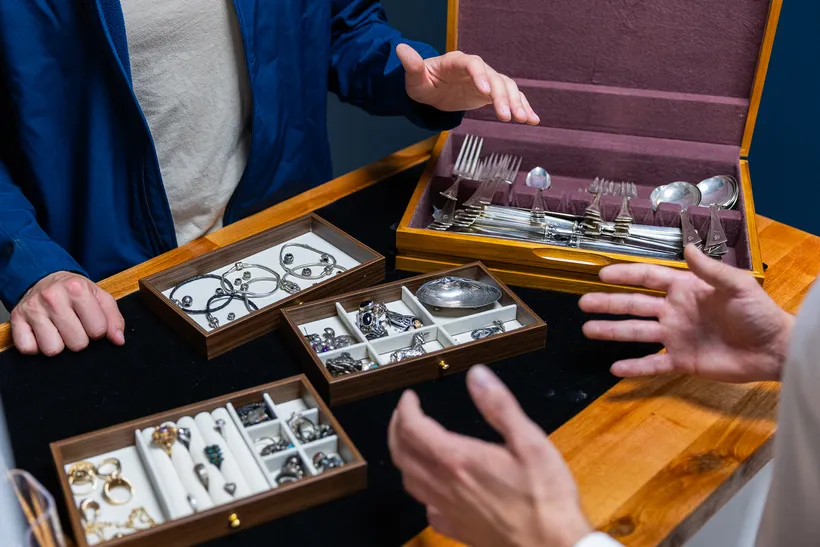
For anyone in Connecticut or the surrounding area, Haven Coin & Jewelry at 2285 Whitney Ave in Hamden buys silver coins, bullion, sterling silverware, jewelry, and full collections. Evaluations are free, in person, and there is no obligation to sell. Items are weighed and evaluated in front of the customer and priced individually against live market information rather than being grouped into one unexplained total.
Walk-ins are welcome Tuesday–Friday from 10am–5pm and Saturday from 10am–2pm. For a larger collection, call (203) 717-4921 to arrange an appointment.
A Price Target Is Not a Guarantee
Silver reaching $200 would be historic. But 2026 has already shown how quickly a dramatic price target can move closer, then suddenly farther away.
Silver went from below $30 to above $120 and then back toward $50 in less than two years. The number on the screen changed constantly. The ounce of silver did not.
FAQ: $200 Silver
Will silver hit $200 an ounce?
Nobody knows. Robert Kiyosaki and Peter Schiff have both predicted $200 silver, but current major-bank forecasts are generally much lower. Reaching $200 would require an unusually strong combination of investment demand, precious-metals strength, market tightness, and other supportive conditions.
Could silver hit $500 an ounce?
It is theoretically possible for silver to reach almost any nominal price, but $500 would require an enormous move from current levels. No mainstream forecast cited here is close to $500.
Who predicted $200 silver?
Robert Kiyosaki predicted $200 silver in a March 16, 2026 X post. Peter Schiff also forecast $200 silver during a July 8, 2026 interview with MINING.COM.
What is the highest silver has ever been?
Silver reached a record nominal price of approximately $121.60 per ounce on January 29, 2026, before falling sharply afterward.
Written by
Matt Pavia
Matt Pavia is a licensed Connecticut precious metals dealer, ANA member, and GIA-trained appraiser with 8 years of experience buying coins, gold, and jewelry. He founded Haven Coin & Jewelry in Hamden, CT in 2025 and is insured through Lloyd's of London.
About Matt & Haven CoinVisit Haven in Hamden
Know what you have.
Understand what it’s worth.
Ready to get a professional evaluation? Visit us at 2285 Whitney Ave, Hamden CT or call (203) 717-4921.
Book Free Appointment Hours & directions