
Silver / Identification
Silver Marks Guide: Sterling, 925 & Silver Plate

A drawer of silver-colored forks, a darkened bracelet, or a pair of heavy candlesticks can leave you with the same question: is this actually silver? Start with the marks, then consider the entire object. A stamp can point you in the right direction, but it cannot authenticate an item by itself.
This guide covers common silver markings and the next steps for an unfamiliar piece. If you are ready for an offer, see our guide to selling silver in Connecticut.
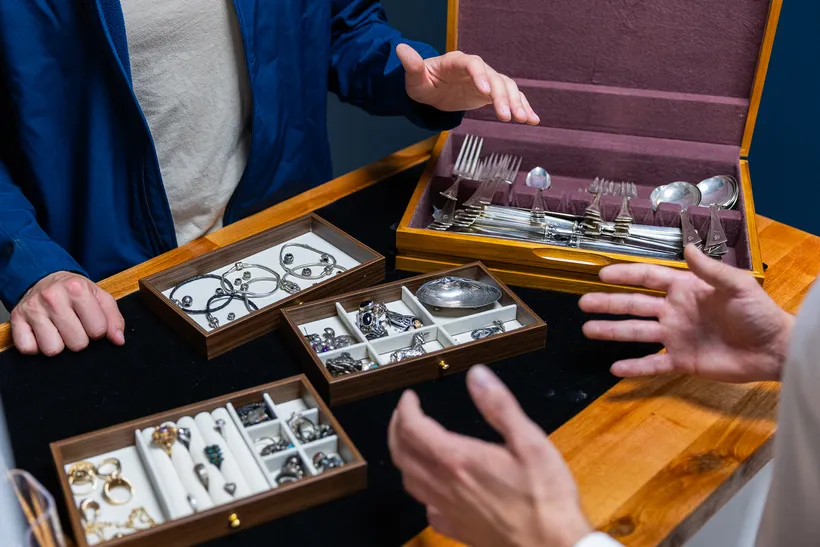
Silver marks at a glance
Read the complete inscription, including words beside the numbers. A pattern number, model number or maker’s name is not necessarily a purity mark. The percentages below explain fineness marks when they genuinely refer to silver.
On a phone, swipe across the table to see all three columns.
| Mark | Usual meaning | What to check |
|---|---|---|
| STERLING / 925 | Sterling silver: 92.5% silver. | Look for additional maker’s marks and mixed-material components. |
| 800 / 900 | 80% / 90% silver when used as fineness marks. | Confirm the number is a metal standard, not a pattern or inventory number. |
| 958 / 999 | 95.8% / 99.9% silver. | Read the accompanying marks and identify the object. |
| EPNS / SILVER PLATE | Silver coating over a base metal; EPNS means electroplated nickel silver. | Do not calculate the entire object’s weight as sterling. |
| NICKEL SILVER / GERMAN SILVER | Names for copper-based alloys, not sterling silver. | The word “silver” describes appearance, not a silver-purity guarantee. |
| STERLING WEIGHTED / REINFORCED | A sterling component with filling or reinforcement. | The total weight includes material that is not sterling. |
The FTC’s silver jewelry guidance explains the sterling standard. For plated materials and nickel silver, see the Canadian Conservation Institute’s metal-identification reference.
Where to look for marks on silverware and jewelry
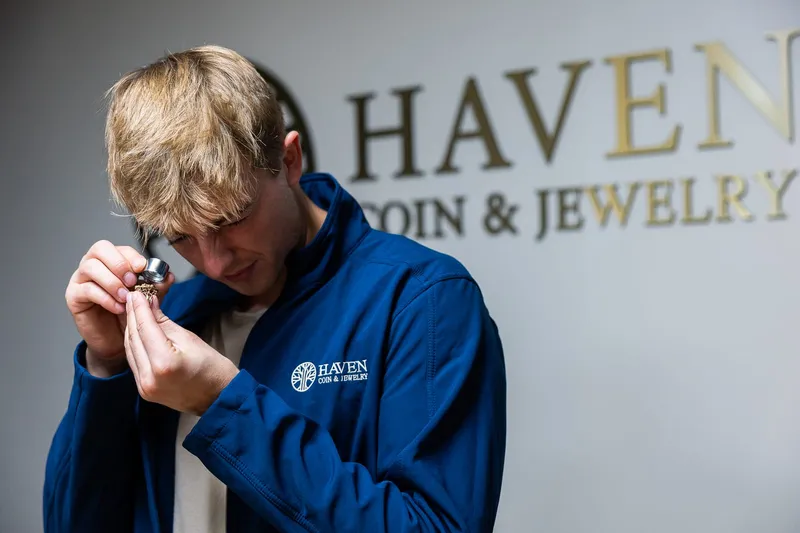
Use good light and a magnifier. Rotate the object rather than scraping or polishing a faint stamp. Photograph every mark before trying to interpret it.
- Spoons and forks: check the back of the handle, including the area near the bowl or tines.
- Knives: examine the handle and blade separately. A blade inscription does not establish the handle’s metal, or vice versa.
- Trays, bowls and candlesticks: inspect the underside, rim and base. A removable base cover may conceal filling; leave it intact.
- Rings: look inside the band.
- Bracelets and necklaces: check clasps, end tabs and nearby links. A marked clasp alone does not authenticate an entire chain.
If pieces look identical, still check more than one. Replacement utensils and mixed sets can combine sterling and plate.
Is 925 real silver?
Yes—925 is the customary fineness designation for sterling silver, an alloy containing 925 parts silver per thousand. It is not the same as pure silver, and it is not the same as silver plate.
For an authentic piece made entirely of 925 alloy, 100 grams of alloy contains 92.5 grams of silver. That example does not apply to a 100-gram object containing stones, steel, filling or other materials. Our silver melt-value guide explains the difference between metal content and an actual offer.
A stamp can be misleading or counterfeit. When an item’s origin is unknown, treat “925” as a useful clue to verify—not a complete appraisal.
British hallmarks: read the whole group
A British hallmark is more than a lone purity number. Modern UK hallmarks include a sponsor’s mark, a fineness mark and an assay-office mark. Additional symbols may include a lion passant for 925 silver, a Britannia figure for 958 silver, and a date letter.
According to Sheffield Assay Office, the date letter became voluntary in 1999. Its typeface, case and surrounding shield matter when dating an object. Do not assign a year from the letter alone, or assume that every lion-like symbol on silver-colored metal is an authentic British hallmark.
Older and imported pieces need the reference appropriate to their place and period. Photograph the complete group of marks rather than cropping to a single symbol.
Silver plate and nickel silver are different from sterling
Silver plate has a silver surface over another material. EPNS identifies electroplated nickel silver: the underlying nickel-silver alloy is not sterling. Nickel silver is commonly a copper, nickel and zinc alloy; despite its name, it is not a silver alloy.
Worn areas showing a different color can be a clue to plating, but appearance alone is not conclusive. Tarnish also does not prove that an item is sterling.
A plated piece can still have decorative or collectible appeal. Its value depends on the actual item and buyer; it should not be priced by multiplying its full weight by the silver spot price. Call Haven before bringing a large plated set so we can discuss what you have.
Why weighted sterling can be misleading
A heavy candlestick may have a sterling exterior surrounding a non-silver core. Some serving pieces and knife handles also combine a silver casing with filling or reinforcement. The scale measures the whole object, not just its silver-bearing portion.
For example, Arch Enterprises documents sterling knife handles containing cement and steel. Construction varies, so there is no reliable universal percentage to subtract from every weighted item.
Leave these pieces assembled. Dismantling them can destroy a usable or collectible object before its value has been considered. Ask an evaluator which components are being weighed and how the offer accounts for them.
What if there is no mark—or the mark is unreadable?
Put the item in an “unidentified” group rather than immediately calling it scrap or plate. Wear, repairs and the object’s age or origin can complicate identification.
A magnet is only a screening clue: many non-silver metals are not attracted to a magnet. A non-magnetic result does not prove silver. Clasps, springs and knife blades can also behave differently from the rest of a piece. Avoid filing, acid testing or other destructive experiments on an unfamiliar object.
For jewelry with gold or mixed-metal stamps, our jewelry hallmark guide covers additional markings. For uncertain silver, a professional evaluation can consider material, construction, condition and potential resale value together.
Prepare your silver for an evaluation
- Take an overall photo. Include the entire item or set, not just the stamp.
- Photograph the marks. Take a sharp close-up and another image showing their location.
- Keep related pieces together. Bring boxes, labels and any existing documentation.
- Leave items as they are. Do not polish coins, scrape marks or dismantle weighted pieces.
- Ask how the offer is calculated. Separate purity and silver-bearing weight from any collectible or resale value.
Haven Coin & Jewelry evaluates silver in Hamden. Learn about our free buying evaluations, review the silver items we buy, or book a free appointment for a collection. We are at 2285 Whitney Avenue; see directions and shop hours before visiting.
Frequently asked questions about silver marks
Does 925 mean sterling silver?
925 is the customary fineness mark for sterling silver, meaning 92.5% silver. The mark still needs to be consistent with the actual item; a stamp alone does not prove authenticity.
Is EPNS sterling silver?
No. EPNS means electroplated nickel silver: a silver coating over a base-metal alloy. The full weight of an EPNS item is not sterling silver.
Does weighted sterling mean the whole item is silver?
No. Weighted sterling pieces include non-silver filling or reinforcement. Their total weight cannot be treated as sterling weight.
Can unmarked silver be valuable?
Possibly. An absent or worn mark does not settle the material or value. Have the item identified before treating it as scrap or silver plate.
Does a magnet prove whether something is silver?
No. Many non-silver metals are not attracted to a magnet, and an item may contain mixed components. A magnet result is only a clue, not a conclusive silver test.
Written by
Matt Pavia
Matt Pavia is a licensed Connecticut precious metals dealer, ANA member, and GIA-trained appraiser with 8 years of experience buying coins, gold, and jewelry. He founded Haven Coin & Jewelry in Hamden, CT in 2025 and is insured through Lloyd's of London.
About Matt & Haven CoinVisit Haven in Hamden
Know what you have.
Understand what it’s worth.
Ready to get a professional evaluation? Visit us at 2285 Whitney Ave, Hamden CT or call (203) 717-4921.
Book Free Appointment Hours & directions