
The Indian Head penny is one of those coins that immediately makes you stop and look twice if you have the luck of finding one in a change jar. Struck from 1859 to 1909, it shows a profile of Liberty wearing a feathered headdress, and it's designed by James B. Longacre. Despite the nickname, the design was never meant to depict a Native American figure. It's "Lady Liberty" herself, styled with the headdress for a distinctly American look at the time.
The reverse changed a bit over the series, starting with a simple laurel wreath in 1859 before switching to an oak wreath with a shield at the top in 1860, and that's the design that stuck around for the rest of the series. We love seeing these come into the shop because they carry so much visible history in a small coin. Half a century of American coinage is compressed into a small, iconic penny.
When Were Indian Head Pennies Made?
The Indian Head penny ran for exactly fifty years, from 1859 through 1909. It was all struck at the Philadelphia Mint except for the final two years, 1908 and 1909, when the San Francisco Mint joined and added its own "S" mint mark to the mix. Before that, every single Indian Head penny came from Philadelphia, which is part of why mint marks only matter for a tiny portion of this series.
This run of half a century lines up with an enormous stretch of American history, spanning from years right before the Civil War all the way through the early 20th century. In 1909, the series came to an end. It was replaced by the Lincoln cent during the same year to celebrate the 100th anniversary of Abraham Lincoln's birth. This design we still use today, albeit with a few changes. Knowing this date range is the quickest way to confirm you're actually holding an Indian Head penny rather than something from an earlier or later series.
What Are Indian Head Pennies Made Of?
The composition of Indian Head pennies notably changed partway through the series. From 1859 through mid-1864, the coins were struck in a copper-nickel alloy, about 88% copper and 12% nickel. This is why early examples have a distinctly pale, almost silvery white appearance compared to later.
Starting in mid-1864, the Mint switched to a bronze alloy, 95% copper with the remaining 5% divided between tin and zinc. This is interestingly because the copper nickel coins were being hoarded during the Civil War and a thinner and cheaper composition helped keep coins circulating. This bronze formula carried the series through to its final year in 1909, and it's the same basic alloy that later wheat pennies also have. If you've got an early copper-nickel example, you're holding a different metal composition than a later bronze Indian Head penny, even though they look similar at a glance.
How Much is an Indian Head Penny Worth?
Most Indian Head pennies from the later, more common years, roughly the 1880s through 1900s, are typically worth somewhere around a dollar or two in worn, circulated condition, mostly due to collector interest in a coin that's a century old rather than scarcity. Better-preserved uncirculated examples, especially ones that have kept their original red or red/brown color, can be a little more valuable.
Earlier dates, especially the copper-nickel issues from 1859 through mid-1864, tend to carry higher values across the board, since fewer were struck and fewer survived in good condition. There's also a handful of true key dates, covered in more detail below, that can be worth hundreds or even thousands of dollars regardless of condition. As always, we'd tell you to check the specific date before assuming a coin's value, since this series has one of the widest value ranges of any common American coin.
What Will a Dealer Actually Pay for Indian Head Pennies?
Here's the part worth knowing before you walk in. There's no melt value to fall back on with a bronze cent, so a dealer is paying entirely for collector demand. Common dates from the 1880s through 1909 in worn condition are bought as a group, not one at a time: a dealer looks through the pile for anything scarce, then makes an offer on the rest by the handful, usually well under a dollar a coin, because that's what the next collector will pay for them. That's not a lowball; it's the market for a coin that 50 million people once carried in their pockets.
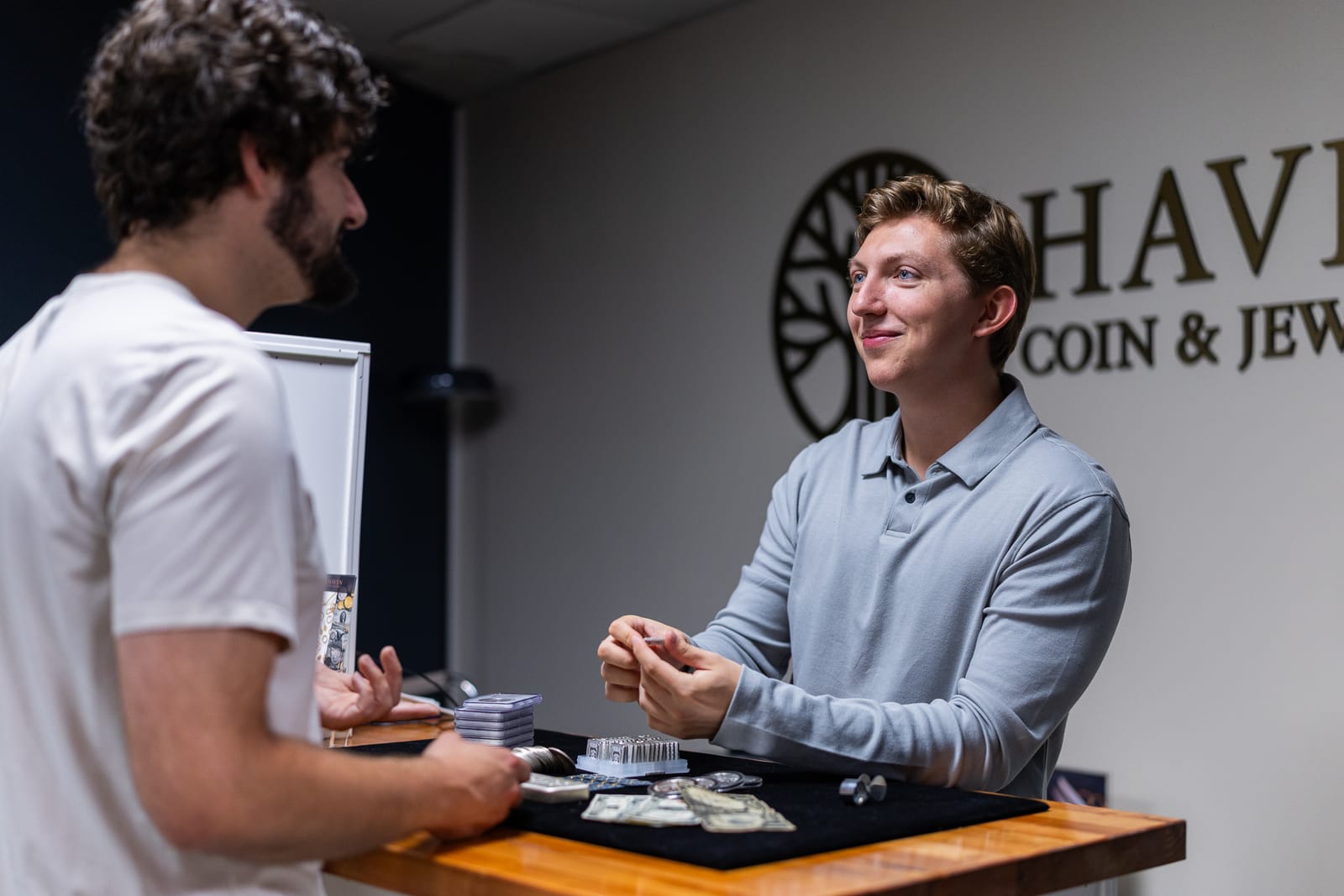
The coins that get pulled out and priced on their own are the ones this article is really about: the 1877, the 1909-S, the 1908-S, the early copper-nickel dates in nice condition, and any later date that still shows full feather detail and original red or red-brown color. Those are priced individually against current references, and the difference between a worn 1877 and a worn 1890 is several hundred dollars sitting in the same jar. Two things cost sellers money here: cleaning (a polished Indian Head cent loses most of its collector premium, and we can tell at a glance), and altered dates on suspected 1877s, which is why any key date gets a close look under the loupe before a number is named. When we go through a batch, we sort it into those groups in front of you so you can see which coins drove the offer.
Licensed Connecticut Dealer • Insured through Lloyd's of London • Free Evaluations • Same-Day Payment
Bring the whole jar to 2285 Whitney Ave, Hamden — we sort by date in front of you and show you which coins drove the offer.
Which Indian Head Penny Dates Are Valuable?
A few dates rise above the rest of the series. The 1877 stands as the undisputed key date, with the lowest mintage of the entire run at 852,500 coins, making it scarce in any condition and quite valuable even when heavily worn. The 1909-S, the final year of the series and one of only two years struck with a mint mark, also commands strong prices thanks to its low mintage of just 309,000. Even though more 1877 cents were struck than 1909-S cents, the 1877 is the more valuable coin, because far fewer survived and collector demand for it is stronger.
Beyond these headline dates, the early copper-nickel issues from 1859 through mid-1864 draw solid collector interest, particularly in higher grades, simply because fewer survived in nice condition. The 1908-S, the first year San Francisco struck this design, is a notable semi-key date as well. If you've got an Indian Head penny with any of these dates, it's worth setting aside for a closer look.
What is an 1877 Indian Head Penny Worth?
The 1877 is the coin every Indian Head penny collector dreams of finding in a jar of old change, and for very good reason. With a mintage of only 852,500, it's a scarce date across the series, and that scarcity holds true from heavily worn examples to pristine uncirculated pieces.
Even a well worn 1877, in circulation for potentially a century, can be worth several hundred dollars, and the value climbs substantially from there as condition improves. High-grade uncirculated examples reach well into the thousands. Because it's the series' most famous key date, the 1877 is also a coin that's occasionally targeted by counterfeiters or altered from more common dates, so any suspected 1877 deserves grading or professional examination at the minimum.
What Is a 1909-S Indian Head Penny Worth?
The 1909-S closes out the Indian Head penny series in dramatic fashion. It's the final year of the design, and even though the San Francisco Mint struck only 309,000 coins that year, the 1877 date generally brings more attention and value.
Nevertheless, even in worn, circulated condition, a genuine 1909-S is worth a decent chunk of change, landing in the hundreds of dollars, and uncirculated examples worth substantially more. Because 1909 was also the year the Lincoln cent debuted, some beginners occasionally confuse the two designs from that year. It's worth double-checking that you're looking at the Indian Head design, headdress and all.
What is a Flying Eagle Cent?
The Flying Eagle cent is technically a separate series, but it's so closely tied to the Indian Head penny's story that we always mention it together. Minted from 1856 to 1858, it was the first small-size cent made by the U.S. Mint. It replaced the larger, heavier copper cents that came before it, and it paved the way for the Indian Head design that followed in 1859. It features a flying eagle on the obverse, also designed by James B. Longacre.
The 1856 Flying Eagle cent is a genuine rarity, struck in small numbers as a pattern before full production began, and it's worth thousands in any condition. The 1857 and 1858 issues, on the other hand, were struck in the millions for actual circulation and are far more affordable and commonly available today. If you come across a Flying Eagle cent, especially one dated 1856, it's 100% worth getting it authenticated.
How Does Condition Affect Indian Head Penny Value?
Condition matters enormously with this series, as with most other series. A key detail collectors look for is how sharply Liberty's headdress and the lettering along her headband are struck and preserved, since wear tends to show up there first and fastest. A coin with fully detailed feathers and clearly readable lettering will always outvalue a similar-date coin where those details have worn smooth and unreadable.
Color matters too, especially for coins from the bronze era (1864 onward). Collectors and grading services distinguish between coins that have kept their original red color (designated RD), ones that have toned to a mix of red and brown (RB), and ones that have gone fully brown with age (BN), and that color designation can significantly change a coin's value even at the identical numerical grade. For any Indian Head penny you think might be valuable, condition is just as important a question to ask as the date is.
How Do You Sell Indian Head Pennies?
Selling Indian Head pennies starts with sorting by date, since even a handful of coins might have a common late-date piece worth a dollar or two right next to a genuine key date worth hundreds. Set aside anything dated 1877, 1909-S, or from the early copper-nickel years (1859 through mid-1864) for a closer look before selling the rest.
We always recommend getting more than one opinion, especially if you suspect you might have a key date. If you're in or around Hamden, Connecticut, stop by Haven Coin & Jewelry for a free, no-obligation evaluation. Walk-ins are welcome during business hours (Tuesday through Friday 10am–5pm and Saturday 10am–2pm), or give us a call to schedule a time if you're bringing in a larger collection. We'll go through your coins right in front of you, show you which ones drove the offer, and pay you by check on the spot, as Connecticut law requires. You can reach us at (203) 717-4921, or find us at 2285 Whitney Ave, Hamden, CT 06518. When you're ready to sell your coins, we're here.
FAQ: Indian Head Pennies
Are Indian Head pennies worth money?
Yes. Even common later dates are typically worth a dollar or two in circulated condition, while key dates like the 1877 and 1909-S can be worth hundreds to thousands.
What is the rarest Indian Head penny?
The 1877 is the scarcest regular-issue date, with the 1909-S following behind.
Are Indian Head pennies copper?
Mostly, though the exact alloy changed. Coins from 1859 through mid-1864 are copper-nickel, while coins from mid-1864 through 1909 are 95% copper bronze.
How much is an Indian Head penny worth?
Common later dates are generally worth a dollar or two in circulated condition, while scarce dates and better grades can be worth substantially more.

Written by
Matt Pavia
Founder & Owner, Haven Coin & Jewelry
Matt Pavia is a licensed Connecticut precious metals dealer, ANA member, and GIA-trained appraiser with 8 years of experience buying coins, gold, and jewelry. He founded Haven Coin & Jewelry in Hamden, CT in 2025 and is insured through Lloyd's of London.
About Matt & Haven Coin →Ready to get a professional evaluation? Visit us at 2285 Whitney Ave, Hamden CT or call (203) 717-4921.
Book Free Appointment