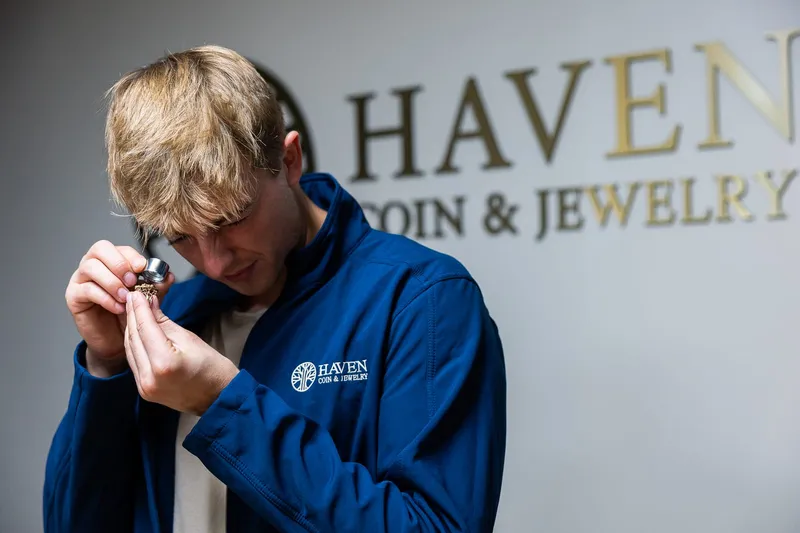

The Stamp Starts the Conversation; Testing Supports the Offer
A ring brought from Poland may use a numeric fineness mark where an American piece uses karats. A service pin can carry a familiar company name without being solid gold. Rather than asking you to solve those differences, we examine the items at the counter and explain what supports the valuation. Separate owners’ belongings before coming, but leave the jewelry itself intact.
Broad Street and downtown New Britain have buyers and jewelers closer to home. For a full jewelry box or an estate containing several metals, our case is a clear process: a licensed, insured buyer, testing and weighing in front of you, and the offer recorded in writing. Haven is a buy-only business, so the conversation does not turn into a proposal to trade your heirloom for something in a sales case.
You can ask how stones, clasps, watch movements, and differing purities affect the number. We will also explain when an item has potential value beyond its metal. If the family needs time, take the offer home. A half-hour-plus journey should leave you understanding the options, whether or not you decide to sell that day.

What Goes Into Your Gold Evaluation
Numeric marks and tested purity
A 585 mark indicates 58.5% gold and is associated with 14-karat jewelry; 750 indicates 75%, or 18 karats. The older 583 mark represents 58.3%, approximately 14 karats, and can appear on Soviet-era pieces. Those numbers describe claimed fineness, not proof that an item is genuine. We examine and test the metal rather than treating a stamp as the final answer. Polish-origin jewelry and American 10k or 14k pieces receive the same item-by-item attention.
Weighing and a market-based offer
After establishing the relevant purity, we weigh the material and explain what is included. Gemstones and non-gold components are not automatically counted as gold weight. The current spot market is a reference for fine metal, while the purchase offer also reflects the item and applicable buying costs. Different karats are kept distinguishable in the explanation. You receive the result in writing, with room to ask how the figures were reached before deciding whether to accept.
Wearable jewelry and broken gold
Rings, bracelets, necklaces, and earrings do not have to be fashionable or complete to contain valuable metal. A broken clasp or missing partner does not remove the gold in the remaining piece. Intact jewelry may also deserve consideration beyond scrap value, depending on its characteristics and market. We look at the actual item rather than promising that every signed piece commands a premium. Bring older appraisals if available, understanding that insurance replacement values differ from purchase offers.
Service jewelry and watch cases
A Stanley service award or an inherited watch may be solid gold, gold-filled, plated, or another material. The company name and the object’s weight cannot settle that question. We inspect construction and marks, then explain the result honestly. Gold-filled pieces contain a layer of gold bonded to another metal rather than solid gold throughout. Leave watch movements and cases together when bringing them; dismantling a keepsake before its evaluation can create unnecessary damage.
Dental gold and investment pieces
Dental gold needs its own composition check because appearance does not establish an alloy’s precious-metal content. Bring fragments separately from wearable jewelry when practical. Gold coins and bars are examined for authenticity, fineness, and weight; certain coins may have collector interest as well. Keep packaging and purchase records if you have them, but neither a receipt nor an assay card replaces examination. Mention mixed bullion and jewelry when scheduling an estate visit.
Platinum and silver
Platinum is evaluated using its own purity and market rather than a gold calculation. Sterling jewelry, flatware, and hollowware can come in with your other items. We distinguish sterling from silver plate and account for weighted bases, hollow handles, and other non-silver material. A large service needs time to assess, so let us know its approximate size when you book.
Connecticut requires licensed precious-metals dealers to use a check or money order for payment, and Haven pays by check. We issue payment the same day you accept; the required holding period for covered purchases does not delay your check.
Directions from New Britain
Two routes from New Britain to our Hamden shop at 2285 Whitney Ave.
From Columbus Boulevard and Elm Street
From central New Britain, reach Route 9 south via Columbus Boulevard and Elm Street. Use exit 32 for the connection to Route 15 south / US-5 south, then follow Route 15 to exit 52 for Whitney Avenue in Hamden. Continue to 2285 Whitney Ave. Look for the light blue building; our sign and parking are at the rear.
From Main Street
Maps also offers a Main Street approach to Route 9 south, joining the same Route 15 south corridor to exit 52. This shares the highway portion of the first route, rather than providing a separate traffic bypass. Both mapped options were about 32–33 minutes from the center; allow roughly 30–40 minutes and check current traffic before leaving.

Our Address
2285 Whitney Ave, Hamden, CT 06518
About 30–40 min from New Britain
Questions About Selling Gold from New Britain
Straight answers to the questions we hear most from New Britain residents.
Helpful Resources
Everything you need to know before your visit from New Britain.
Sell Gold Jewelry in CT
How selling gold works at a licensed CT dealer — testing, karat confirmation, and payment.
Learn moreWhat We Buy
A full list of coins, jewelry, metals, and collectibles we purchase.
Learn moreFree Appraisals
Professional jewelry and gold evaluations with no obligation to sell.
Learn moreGold Karat Value Guide
What 10K, 14K, 18K, and 22K mean for your payout — purity percentages and how each karat is priced.
Read guideGold Spot Price Explained
How the gold spot price works, why it moves, and how your offer is calculated.
Read guideGold Coin Value Guide
How gold coins are valued — bullion, numismatic, and semi-rare pieces compared to spot.
Read guideJewelry Hallmarks Guide
How to read stamps and hallmarks — 10K, 14K, 18K, 750, 925, PLAT and what they mean for value.
Read guideWhat Is Gold-Filled Jewelry?
How bonded gold layers differ from solid gold and why construction matters.
Read guide