
What Are State Quarters?
State quarters are the 50 special quarters the U.S. Mint released from 1999 through 2008 as part of the 50 State Quarters Program. Each one had George Washington on the front and swapped the eagle on the back for a design that represented a state. The Mint released five new designs a year, in the order the states joined the Union, starting with Delaware and ending with Hawaii.
The program was a hit, and a lot of people started saving them. The Mint struck billions of these coins, and they ended up in pockets, jars, and coin folders all over the country. We see them in the shop all the time, usually in a drawer or a piggy bank. Because so many were made, the typical state quarter is nothing special, but a small handful of errors and varieties have real collector value.
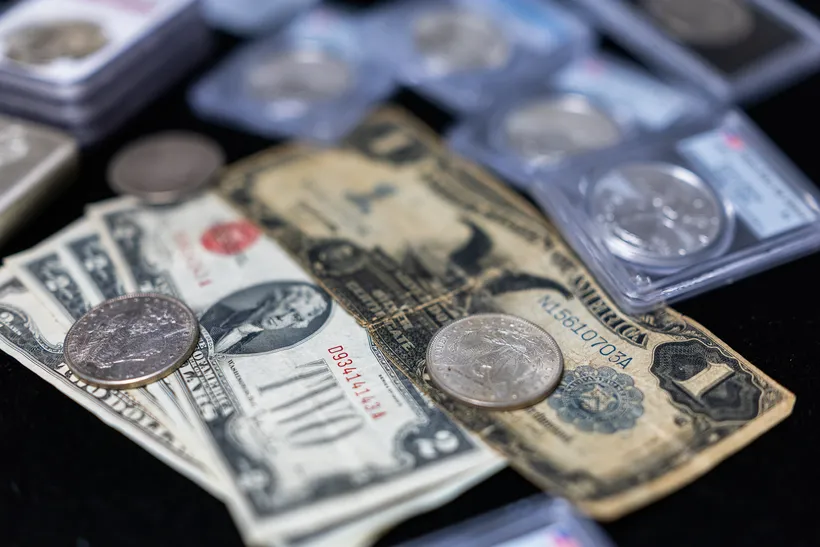
Are State Quarters Worth More Than Face Value?
For the most part, no. A circulated state quarter from your pocket change is worth 25 cents, and a clean, uncirculated one might fetch a little more from a collector, but it’s usually not much. The sheer number made is the main reason. When billions of coins are struck and millions of people save them, there’s no scarcity to drive up the price.
There are exceptions, though. The special silver proof versions (covered below) are worth more than face because of their silver content, and a few errors and varieties are worth real money. So the answer we give customers is that you probably don’t have something you can retire on in your jar, but it’s worth taking a few minutes to check for the ones that stand out. That check is easy, and we’ll walk through what to look for.
What State Quarter Errors Are Worth Money?
A few well-known mistakes make the list, and they involve different causes, including die damage, hubbing varieties, and material filling parts of a die (the metal stamp that strikes the coin). The famous ones are the 2004 Wisconsin “Extra Leaf” quarters, the 1999 Delaware “Spitting Horse,” the 2005 Minnesota doubled die, and the 2005 Kansas “In God We Rust.” We’ll look at each one in its own section.
Beyond those, state quarters can have the same kinds of errors found on any coin, like off-center strikes, clipped planchets (where the metal blank is missing a piece), or doubled dies. Value depends on how dramatic the error is, how well documented it is, and the condition of the coin. A tiny flaw is worth little, while a clear, well-known variety in nice condition can bring real money. Most of what people find turns out to be ordinary damage, which is why we’d always suggest having a suspected error checked.
What is the 2004 Wisconsin Extra Leaf Quarter?
The Wisconsin quarter shows a cow, a wheel of cheese, and an ear of corn. On certain 2004-D coins, there’s an extra leaf on the corn. It’s the best-known error in the series. It was caused by a gouge in the die, and it comes in two varieties. On one, the extra leaf points up and is called “high.” On the other one, it points down and is called “low.”
Only coins from Denver, with a “D” mint mark, carry the extra leaf. Genuine examples can bring meaningful premiums, but the exact variety and grade matter; compare recent completed sales rather than assuming a fixed price. For perspective, PCGS records a $2,530 auction result for an MS66 Extra Leaf High in 2006; that exceptional historical sale is not a typical offer for a circulated coin. Be careful, since altered coins exist: a genuine extra leaf is raised metal that’s part of the design, not something scratched or added after the fact.
What is the 1999 Delaware Spitting Horse Quarter?
Delaware was the first state quarter, and its design shows Caesar Rodney on horseback. On some 1999-P quarters, a die crack near the horse’s mouth left a thin raised line that looks like the horse is spitting. It’s a Philadelphia coin, and the line sits between the “C” and the “A” in “CAESAR” on the coin.
When it was first discovered, collectors paid a good amount for these, but the price has come down since many turned up. Its premium depends on condition and how clearly the die crack appears; compare recent sales of the same variety rather than relying on a fixed price. It’s still a fun find, and it’s an easy one to check for with a magnifier. A real one shows a raised line on the surface, not a scratch cut into the coin.
What is the 2005 Minnesota Doubled Die Quarter?
Minnesota’s quarter shows a lake with pine trees and the state’s outline, along with the phrase “Land of 10,000 Lakes.” On some coins, the trees in the background look doubled, with an extra tree appearing next to the real ones. This doubling originated while the die was being made, rather than from the coin being struck twice; modern single-squeeze hubbing can still produce doubled dies.
There are many varieties, and they range from minor to dramatic. The more noticeable the doubling is, the more the coin is typically worth. The prominent FS-801 Doubled Tree variety should be distinguished from the many minor varieties before comparing prices. A magnifying glass is your best tool. Real doubling shows a clear, rounded second image, while a flat smear is usually just machine doubling and isn’t worth extra.
What is the 2005 Kansas In God We Rust Quarter?
Kansas’s quarter features a bison and sunflowers, and it carries the motto “In God We Trust.” On certain coins, the first “T” in “Trust” looks missing, so it appears to read “In God We Rust.” The commonly cited explanation is that grease filled in part of the die, so the letter didn’t strike up properly.
It’s a fun story, but a missing letter alone does not prove a mint error. A filled-die strike can leave a weak or missing letter without removal marks, but surface appearance alone cannot authenticate it. If there’s roughness or tool marks, someone has probably removed the letter after the coin left the Mint, which means it’s damaged, not an error. We’d treat any “In God We Rust” with caution and have it authenticated before you pay or expect real money for it.
Are Silver Proof State Quarters Worth More?
Yes, in general. From 1999 to 2008, the Mint offered special proof versions of the state quarters in silver, struck at San Francisco and sold in collector sets. These are 90% silver and 10% copper, weigh 6.25 grams, and contain about 0.18084 troy ounces of pure silver.
To find the silver value, multiply 0.18084 by the live silver price at Kitco’s silver price chart. That’s the general value, and collectors may pay a bit more for coins in original condition. Prices vary a lot by source, and a few designs are scarcer than others. The Mint also sold separate clad proof sets; those quarters lack the silver-content value. If you’re sorting through a set, the label and the coin’s weight will tell you which is which. Both clad and silver proofs can have mirror-like finishes and sharp details, so finish and an S mint mark alone do not establish silver content.
How Can You Tell a Real Error From Damage?
This is the most important question, and it’s the one we get most often. A real error happens at the Mint, and it affects the coin in a way that looks natural: the metal flows with the error, and the design is consistent. Damage happens afterward, to a coin that’s already finished, and it tends to look rough or random.
A few clues help. Scratches, gouges, and bent edges are signs of damage. A flat spot or rough pitting where a letter should be suggests something was removed. Some die cracks and gouges create raised features, but other genuine errors look different, so no single surface clue proves authenticity. A magnifying glass and a strong light help a lot, and comparing your coin to reference photos of the real thing is smart. Please DO NOT clean the coin, since that can wipe out any value. If you’re not sure, bring it in and we’ll take a look.

How Do You Sell State Quarter Errors?
Start by checking your quarters one at a time, and set aside anything that looks like one of the famous errors. Handle them by the edges, don’t clean them, and keep any that are in original sets together. If you’ve got silver proofs, use the live silver price at Kitco’s silver price chart to work out a baseline.
We always recommend getting more than one opinion before selling anything you think might be valuable. If you’re in or around Hamden, Connecticut, stop by Haven Coin & Jewelry for a free, no-obligation evaluation. No appointment necessary, just walk in during business hours (Tuesday–Friday 10am–5pm and Saturday 10am–2pm), or give us a call to schedule a time if you’re bringing in a larger collection. We’re a licensed Connecticut precious metals dealer, not a pawn shop, and we’ll go through your coins right in front of you, price them individually against live market prices, and give you a written offer to keep. You can reach us at (203) 717-4921, or find us at 2285 Whitney Ave, Hamden, CT.
FAQ: State Quarter Errors
Are state quarters worth money?
Most are worth face value (25 cents). Silver proof versions, certain errors, and high-grade coins can be worth more.
What is the rarest state quarter?
There is no single answer across regular coins, varieties, and mint errors. Wisconsin Extra Leaf High and Low are well-known collectible varieties, but other rare errors and exceptional grades can be more valuable.
What is the Wisconsin extra leaf quarter worth?
Value depends on whether it is Extra Leaf High or Low, its grade, authenticity, and current demand. Compare recent completed sales of the same variety and grade; exceptional historical auction results are not typical dealer offers.
Where can I sell state quarter errors?
Local coin dealers, reputable online buyers, and auction houses all buy them. Getting more than one opinion helps ensure a fair price.

Written by
Matt Pavia
Matt Pavia is a licensed Connecticut precious metals dealer, ANA member, and GIA-trained appraiser with 8 years of experience buying coins, gold, and jewelry. He founded Haven Coin & Jewelry in Hamden, CT in 2025 and is insured through Lloyd's of London.
About Matt & Haven CoinVisit Haven in Hamden
Know what you have.
Understand what it’s worth.
Ready to get a professional evaluation? Visit us at 2285 Whitney Ave, Hamden CT or call (203) 717-4921.
Book Free Appointment Hours & directions