
Should You Sell Silver Now or Wait? How to Decide Without Guessing
 By Matt Pavia · 8 min read
Silver creates a frustrating question because you only learn the perfect time to sell after it has already passed.
Sell today and the price could rise next month. Wait for a higher number and silver could fall instead. There will always be someone online insisting they know exactly what happens next.
They do not.
A better way to decide has almost nothing to do with predicting tomorrow’s price. It starts with understanding what you own, what it is worth today, and why you are considering selling in the first place.
Put today’s silver price in context
For a dated reference point, Pyromet listed silver at $54.195 per troy ounce on October 23, 2026. That price can change every few seconds while markets are open, so anyone reading this later should check the live silver price on Kitco rather than relying on a number from this article.
Today’s price also needs context. Silver reached a record above $121 in January 2026 before falling sharply. Someone looking only at January might think today’s price looks low. Someone who remembers silver trading below $30 at the beginning of 2025 might look at the same $54 and think it looks high.
Both people are looking at the same ounce of silver.
That is exactly why the question “Should I sell now or wait?” does not have one answer for everyone.
Why predicting silver prices is not a plan
Nobody knows with certainty where silver goes next.
Silver prices respond to interest rates, the strength of the U.S. dollar, industrial demand, mine supply, investment demand, global events, and trader sentiment. Several of those forces can change at the same time, sometimes in opposite directions.
Even professionals who study commodity markets every day regularly disagree about where silver is heading.
That does not mean you have no way to make a decision. It means your decision should not depend on pretending you know the future.
When selling silver can make sense
Selling silver can make sense when the money has a useful purpose in your life today.
Maybe you inherited silver that you never planned to collect. Maybe you have accumulated bullion for years and want to turn part of it into cash. Maybe you are simplifying an estate, paying an expense, reducing the amount of valuables stored at home, or simply deciding that you would rather use the money somewhere else.
None of those decisions require silver to be at an all-time high.
The question becomes whether the value available today works for what you need.
When waiting can make sense
Waiting can also make sense.
You may have no reason to sell. You may enjoy owning the coins or bullion. The silver may have sentimental value, or selling it today may create a tax situation you have not yet considered. You might also still need time to determine whether certain coins have collector value beyond their silver content.
Waiting does not guarantee a better price.
It simply means keeping the silver makes more sense for you right now.
That distinction is important. “I am keeping this because I want to own it” is very different from “I know silver will be higher next year.”
One is a personal decision. The other is a prediction.

Know what kind of silver you own
What kind of silver you own matters too.
A one-ounce .999 fine bullion round is relatively straightforward. Its value is tied closely to the amount of silver it contains and the current market for that particular product.
Sterling silver is different. Sterling is 92.5% silver, so its basic metal value depends on both its weight and purity.
Junk silver, such as common pre-1965 U.S. dimes and quarters, is generally 90% silver. Kennedy half dollars dated 1965 through 1970 contain 40% silver.
The basic starting point is:
weight in troy ounces × silver purity as a decimal × live silver price per troy ounce
But that formula only tells you the metal value.
Check collector value before melt value
Coins can be a completely different story.
A common worn Roosevelt dime may be valued mainly for the silver inside it. A scarce Mercury dime containing nearly the same amount of silver could be worth far more because collectors want the specific date and mintmark.
The same problem comes up with Morgan dollars.
Treating an 1893-S Morgan dollar as nothing more than 90% silver would obviously miss what makes the coin valuable. Better dates, rare varieties, high-grade coins, and pieces certified by services such as PCGS or NGC may all carry value beyond their metal content.
That is why you should never automatically dump an entire coin collection into a “silver” pile.
Check the dates and mintmarks first.
Understand the tax implications
Taxes are another part of the decision that people sometimes forget.
For federal tax purposes, silver bullion and coins held as investments are generally capital assets. If you sell for more than your adjusted cost basis, the difference may be a taxable capital gain.
How long you owned the silver matters.
Silver held for one year or less generally produces a short-term capital gain, which is taxed at ordinary income rates. Long-term gains on collectibles such as silver bullion and coins can be taxed at a maximum federal rate of 28%, although your actual rate can be lower depending on your tax situation.
Your basis also matters. For something you bought yourself, the starting point is generally what you paid. Inherited or gifted silver can follow different basis rules, which is why someone selling a large inherited collection may want to talk with a tax professional before completing the sale.
State taxes can matter too.
This does not mean taxes should decide whether you sell. It means they should be part of the information you understand before making the decision.
You can sell part of your collection
You also do not have to choose between selling everything and selling nothing.
Selling part of a silver collection can be a reasonable middle ground.
Someone with 200 ounces of bullion, for example, might decide they only need the money from part of it. Someone who inherited a coin collection might sell common silver while keeping the pieces with family significance. Another person might separate collectible coins from bullion and make different decisions about each group.
There is no rule saying every ounce has to leave at the same time.
What to check before selling silver
Before selling anything, start by figuring out exactly what you have.
Separate bullion from coins. Check dates and mintmarks. Keep certified coins in their holders. Look for markings such as .999 on bullion or STERLING / .925 on silverware and jewelry.
Then check the live silver price on Kitco. For ordinary silver, knowing the weight, purity, and current spot price gives you a basic reference point before you walk into a dealer.
It is also worth understanding that the spot-price calculation is not automatically the same as a dealer’s offer.
A dealer has to consider what the item is, how easily it can be resold, refining or processing costs where applicable, current demand, and any collector premium. A recognizable one-ounce bullion coin, a bag of worn silver dimes, sterling flatware, and a rare certified coin should not all be evaluated the exact same way.
Ask how the offer was reached.
You should understand whether something is being valued for its silver content, its collector value, or both.
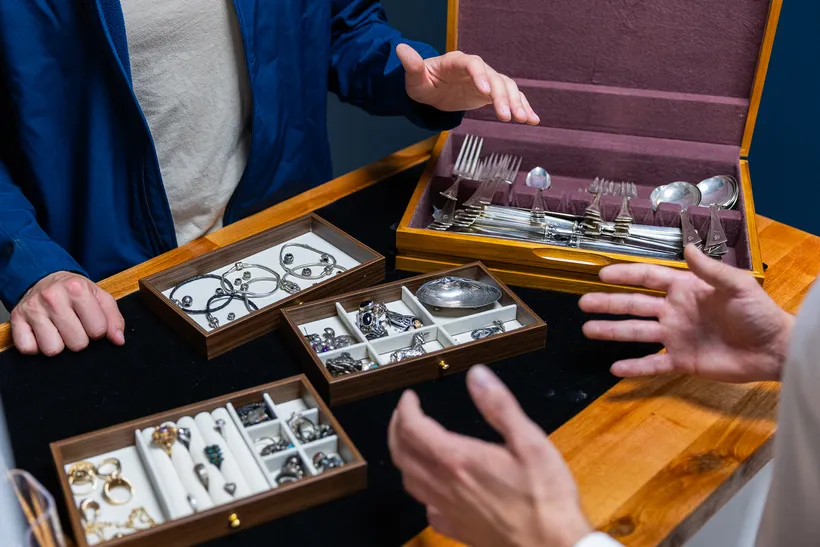
Selling silver in Hamden, Connecticut
If you decide selling silver fits your situation, Haven Coin & Jewelry at 2285 Whitney Ave in Hamden, Connecticut buys silver coins, bullion bars and coins, sterling silverware, jewelry, and full collections.
Evaluations are free, in person, and there is no obligation to sell. Items are tested and weighed in front of the customer and priced individually against live market information rather than simply being grouped into one unexplained total. The customer is also given a written figure to keep.
Walk-ins are welcome Tuesday, Wednesday, and Friday from 10am–5pm, Thursday from 10am–7pm, and Saturday from 10am–2pm. For a larger collection, call (203) 717-4921 to arrange an appointment. Haven is a licensed Connecticut precious metals dealer, not a pawn shop.
If you choose to sell, payment is made the same day by check. Connecticut law requires licensed precious-metals dealers to verify a government-issued photo ID and pay by check or money order rather than cash. Those requirements create a transaction record that can help law enforcement recover stolen property.
The hardest part about deciding when to sell silver is accepting that you will never know the future price in advance.
But you do not need to.
You can know what you own. You can know what it is worth today. You can know whether the money would be more useful to you than the silver.
Sometimes that is enough to make a decision without guessing what tomorrow will bring.
FAQ: Selling Silver Now or Later
Is now a good time to sell silver?
There is no universal “best” time. Nobody can reliably predict future silver prices. A better question is whether today’s value works for your financial needs and whether you still want to own the silver.
Will silver prices go up again?
They could rise or fall. Silver prices depend on interest rates, the dollar, industrial and investment demand, supply, and global events, and future prices cannot be predicted reliably.
Should I sell my silver coins or bars first?
Check the coins before selling anything. Some coins may have collector value beyond their silver content, while ordinary bullion is generally valued more directly around its metal content and market demand.
How much will a dealer pay for silver?
There is no single percentage that applies to every item. An offer depends on the silver’s weight, purity, current spot price, product type, condition, collector value, and current resale or refining market. A reputable dealer should be able to explain how the offer was calculated.
Written by
Matt Pavia
Founder & Owner, Haven Coin & Jewelry
Matt Pavia is a licensed Connecticut precious metals dealer, ANA member, and GIA-trained appraiser with 8 years of experience buying coins, gold, and jewelry. He founded Haven Coin & Jewelry in Hamden, CT in 2025 and is insured through Lloyd's of London.
About Matt & Haven Coin →Ready to get a professional evaluation? Visit us at 2285 Whitney Ave, Hamden CT or call (203) 717-4921.
Book Free Appointment