
Paper Currency
How Much Is an Old $20 Bill Worth? Check for a Brown Seal

An old $20 bill can look like something that belongs in a museum and still be worth only a little more than twenty dollars. Another note from the same general period can be worth hundreds or even thousands.
The difference is often sitting in plain sight.
A seal color, a star in the serial number, an unusual overprint, or a bill that somehow survived decades without being folded can change what collectors are willing to pay. On old $20 bills, one of the easiest details to notice is the color of the Treasury seal. Most people are used to seeing green. If the seal is brown or yellow, it is worth slowing down before spending the note.
What Counts as an Old $20 Bill?
There is no official year when a $20 bill becomes “old.” For collectors, the term usually means earlier designs that no longer commonly appear in circulation. One useful dividing point is the older small-portrait design used before the Series 1996 redesign, introduced for the $20 in 1998. Notes from the 1928, 1934, and 1950 series look much more like one another than they do a modern $20, with Andrew Jackson in a smaller portrait on the front and the White House on the back.
Age by itself does not create value. The exact series, Federal Reserve district, seal color, serial number, star status, and condition all matter. That is why two bills printed decades apart can sometimes be worth nearly the same amount, while two bills from the same year can have completely different collector values.
How Much Is a 1928 $20 Bill Worth?
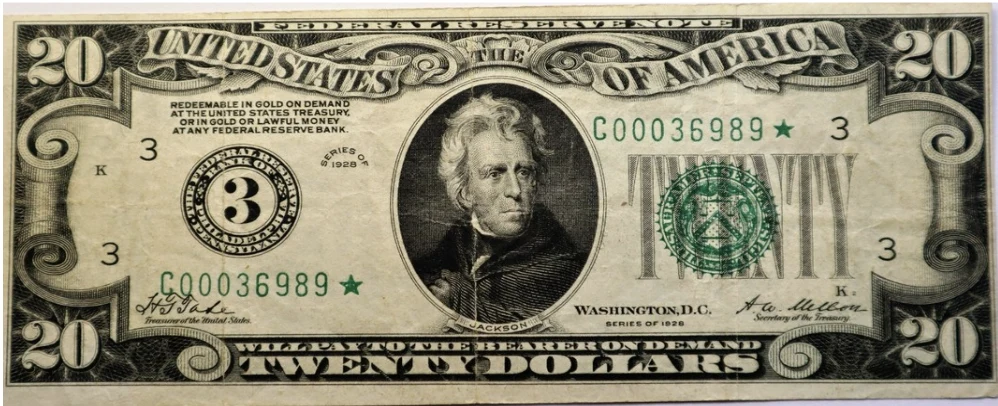
The Series 1928 $20 Federal Reserve Note is a good place to start. It was part of the first generation of small-size Federal Reserve Notes after U.S. paper money was reduced to the dimensions we still use today. Ordinary circulated examples can sell for only a modest premium over face value, while crisp examples are worth more. Current collector guides generally place regular 1928 notes across a broad range starting around $30, with high-grade examples reaching several hundred dollars.
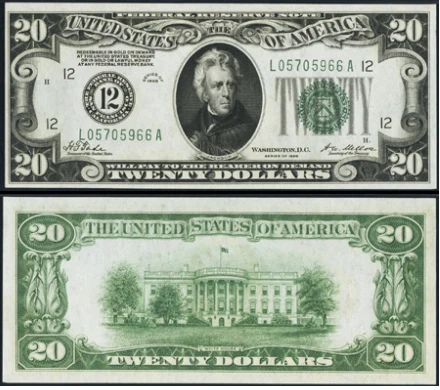
The exact Federal Reserve Bank can make a big difference. Certain districts are harder to find, and star replacement notes can be much scarcer. Some 1928 $20 star notes and better district combinations reach well into the hundreds or thousands. So if you find a 1928 note, do not stop after reading the year. Check the Federal Reserve letter and look at the serial number too.
What Is a 1934 $20 Bill Worth?
The 1934 series is more common. Standard green-seal 1934 $20 Federal Reserve Notes were produced in large numbers, and many circulated examples are worth only slightly more than $20. Better-preserved notes can move into the $50, $100, or higher range depending on the series and district.
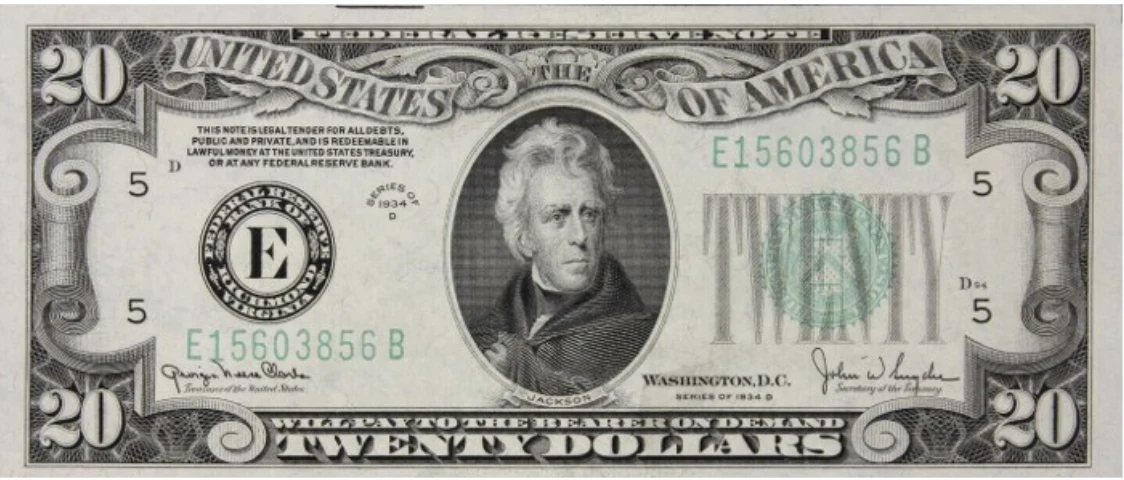
There are several versions, including 1934, 1934A, 1934B, 1934C, and 1934D. Star notes and unusually high grades can be worth considerably more than ordinary worn examples. This is also where one of the most interesting old $20 bills appears: the wartime Hawaii note.
Why Does a Hawaii $20 Bill Have a Brown Seal?
A Hawaii $20 looks similar to a normal 1934-series bill at first. Then you notice the brown Treasury seal and brown serial numbers. Turn the note over and a large word—HAWAII—is printed across the back.
These were emergency notes created during World War II. After the attack on Pearl Harbor, the U.S. government worried that Japan could invade Hawaii and capture large amounts of American currency. Special $1, $5, $10, and $20 notes were put into circulation there in 1942. Because they carried the Hawaii overprint and brown seals, the government could quickly identify and invalidate them if the islands were occupied.
That invasion never happened, but the notes survived as pieces of wartime history.
Series 1934 and 1934A Hawaii $20 notes are both collectible today. Recent 2026 auction results show circulated 1934A examples around the low hundreds depending on grade, while better uncirculated notes can sell for hundreds or more than $1,000. Scarcer star notes can reach several thousand dollars.
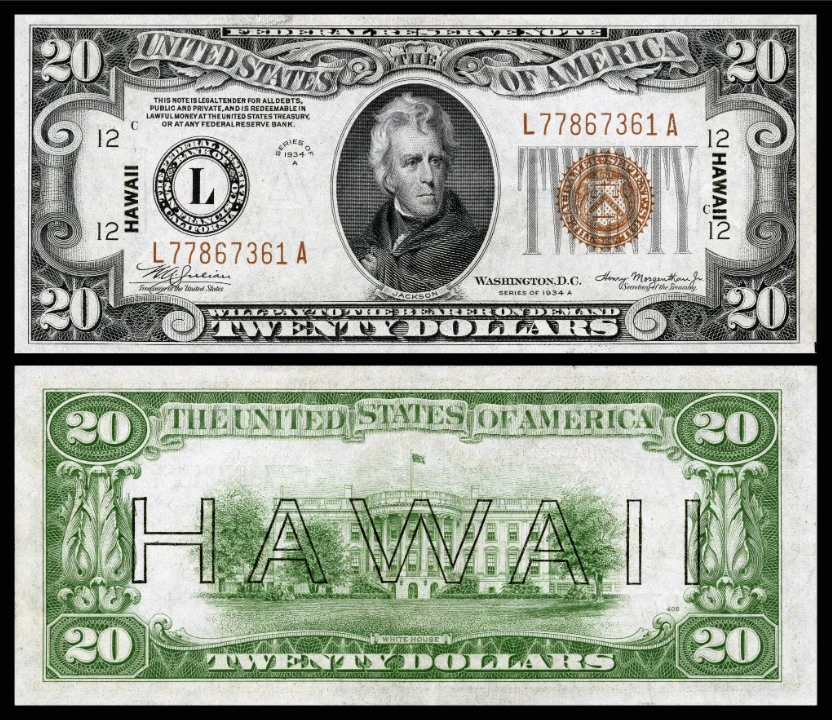
The brown seal is therefore worth checking, but it is important not to assume every brown-seal $20 is from Hawaii. Some 1929 National Bank Notes and Federal Reserve Bank Notes also use brown seals. On a genuine Hawaii emergency note, the large HAWAII overprint makes the identification much easier.
How Much Is a 1950 $20 Bill Worth?
By the 1950 series, ordinary old $20 bills become less exciting to collectors unless something else makes the note special. Regular 1950 Federal Reserve Notes generally range from around face value in circulated condition to roughly $100 or more for better uncirculated examples. Current guides put many standard examples across a range of approximately $20 to $140.
That does not mean every 1950 bill is ordinary. Series letters run through several versions, including 1950, 1950A, 1950B, 1950C, 1950D, and 1950E. Star notes, unusual serial numbers, printing errors, and exceptionally crisp notes can carry larger premiums.
What Is a Yellow-Seal $20 Gold Certificate Worth?
Then there is a completely different kind of old $20: the Gold Certificate.
The small-size Series 1928 $20 Gold Certificate shows Andrew Jackson but has a yellow or gold-colored Treasury seal and gold-colored serial numbers instead of the familiar green. Gold Certificates once represented gold held by the U.S. Treasury. They can no longer be redeemed for gold, but collectors still value them for their history and appearance.
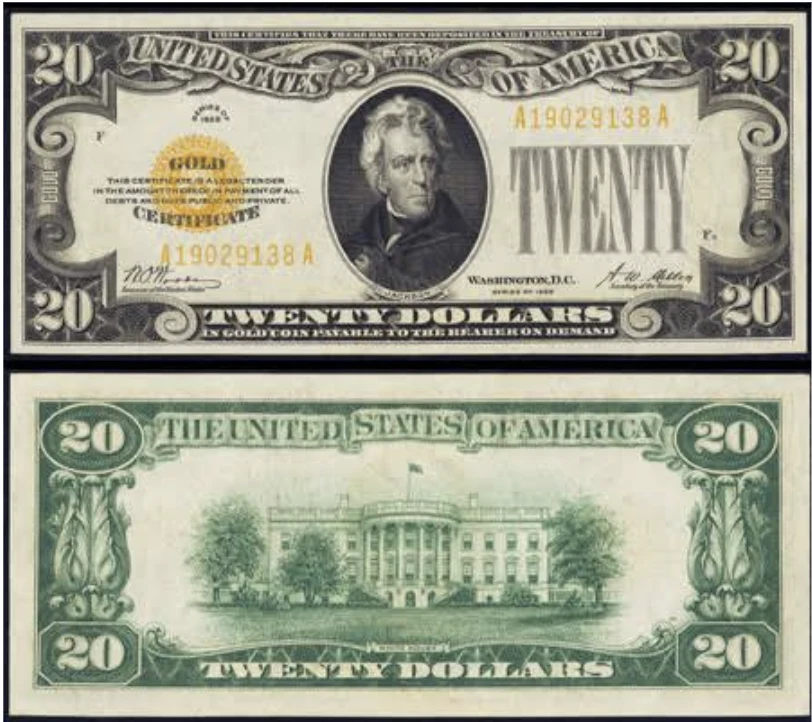
A circulated 1928 $20 Gold Certificate can be worth roughly $85 to $250 depending on condition, while crisp uncirculated examples can reach around $500 to $1,500. Star notes can be worth several thousand dollars. If an old $20 has a yellow seal, it deserves more attention than a normal green-seal Federal Reserve Note.
Do Star Notes and Fancy Serial Numbers Add Value?
Seal color is only one clue. The serial number can matter too.
A star note was printed to replace another note that was rejected during production. Instead of recreating the same serial number, the Bureau of Engraving and Printing used a replacement serial number containing a star. Some replacement runs were large and common, while others were much smaller.
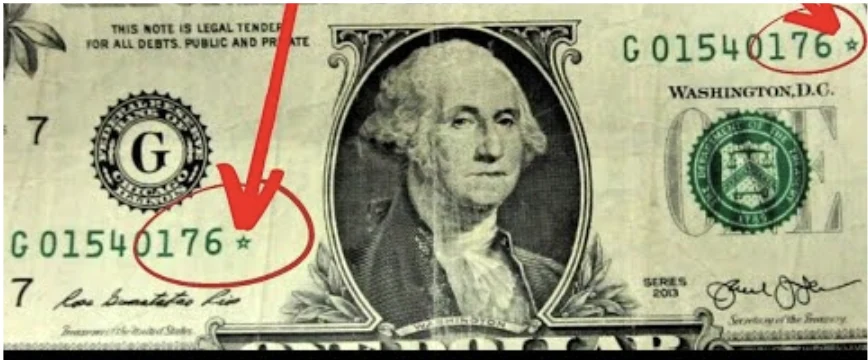
Fancy serial numbers are another area collectors watch. Very low numbers, repeating patterns, radar numbers that read the same forward and backward, and solid numbers made entirely from one digit can carry premiums. Most serial numbers are completely ordinary, but it only takes a few seconds to check.
Why Condition Matters
Condition affects nearly every old bill.
Collectors pay attention to folds, stains, tears, writing, rounded corners, crispness, centering, and whether the paper still looks original. A $20 bill folded into a wallet for fifty years will usually bring less than the same exact note stored flat and untouched.
Do not try to improve it yourself. Ironing a bill, washing it, taping a tear, or erasing writing can make the note less desirable. Keep it flat and protected while you figure out what you have.
Can You Still Spend an Old $20 Bill?
Old $20 bills are also still money. U.S. government policy is that old- and new-design Federal Reserve Notes remain legal tender at face value. A genuine old $20 can therefore still be spent as twenty dollars.
That does not mean you should spend it before checking it.
A normal circulated 1985 $20 bill, for example, is generally worth around its $20 face value or only a small premium. Current guides put ordinary examples around $22 to $33, with crisp uncirculated pieces somewhat higher. A 1985 star note, fancy serial number, or genuine printing error can be worth more. The year alone does not make it rare.
What to Check Before Selling an Old $20 Bill
If you find an older $20, start with the series year and seal color. Then check for a star, unusual serial number, Hawaii overprint, Federal Reserve district, and overall condition. Those few details can usually tell you whether you have an ordinary older note or something that deserves a closer look.
For anyone in Connecticut or the surrounding area, Haven Coin & Jewelry at 2285 Whitney Ave in Hamden buys paper currency and offers free, no-obligation evaluations. Walk-ins are welcome Tuesday–Friday from 10am–5pm and Saturday from 10am–2pm. For a larger currency or estate collection, call (203) 717-4921 to arrange an appointment.
Small Details Can Make a Big Difference
An old bill may have crossed thousands of hands without becoming anything more than spending money. Another may have survived a war, been printed as a replacement, or simply stayed crisp while nearly every other example wore out.
Sometimes all it takes to tell the difference is noticing that the seal is the wrong color.
FAQ: Old $20 Bills
What old $20 bills are worth money?
Older notes with scarce series or districts, brown or yellow seals, Hawaii overprints, star serial numbers, fancy serial numbers, printing errors, or unusually high grades can be worth more than face value.
Is a 1985 $20 bill worth anything?
Most circulated 1985 $20 bills are worth around face value or a small premium. Crisp examples, star notes, fancy serial numbers, and genuine errors can be worth more.
Can you still spend an old $20 bill?
Yes. Genuine older-design U.S. Federal Reserve Notes remain legal tender at face value, although a collectible note may be worth more than $20 to a collector.
What is a brown seal $20 bill?
Several types of older $20 bills used brown seals, including 1929 National Bank and Federal Reserve Bank Notes. The best-known are the 1934 and 1934A Hawaii emergency notes, which have brown seals and a large HAWAII overprint.
Written by
Matt Pavia
Matt Pavia is a licensed Connecticut precious metals dealer, ANA member, and GIA-trained appraiser with 8 years of experience buying coins, gold, and jewelry. He founded Haven Coin & Jewelry in Hamden, CT in 2025 and is insured through Lloyd's of London.
About Matt & Haven CoinVisit Haven in Hamden
Know what you have.
Understand what it’s worth.
Ready to get a professional evaluation? Visit us at 2285 Whitney Ave, Hamden CT or call (203) 717-4921.
Book Free Appointment Hours & directions