
A hundred-dollar bill can sit in a drawer for seventy years and still be worth exactly $100.
Or it can be worth hundreds, thousands, or sometimes much more.
The strange part is that the difference may not be obvious at first. Two old $100 bills can both show Benjamin Franklin, both look worn, and both still be spendable money. But one small detail—a red seal, yellow seal, star, unusual serial number, or exceptionally clean condition, can completely change what a collector is willing to pay.
That is why an old $100 bill should be looked at before it is spent.
What makes a $100 bill old?
There is no official age where a $100 bill suddenly becomes “old.” For collectors, the term usually refers to earlier designs and series that no longer commonly appear in circulation.
One easy dividing point is 1996. Before then, $100 Federal Reserve Notes used the smaller portrait of Benjamin Franklin that many people call the small-head or small-face design. Older notes from the 1928, 1934, and 1950 series look even more different from today’s money.
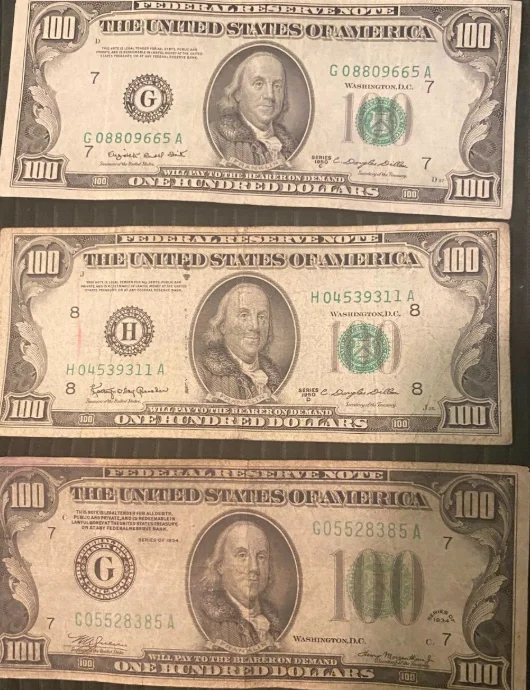
But age alone does not determine value.
The exact series, type of note, Federal Reserve district, serial number, seal, star status, and condition can all matter.
Series 1928 $100 bills
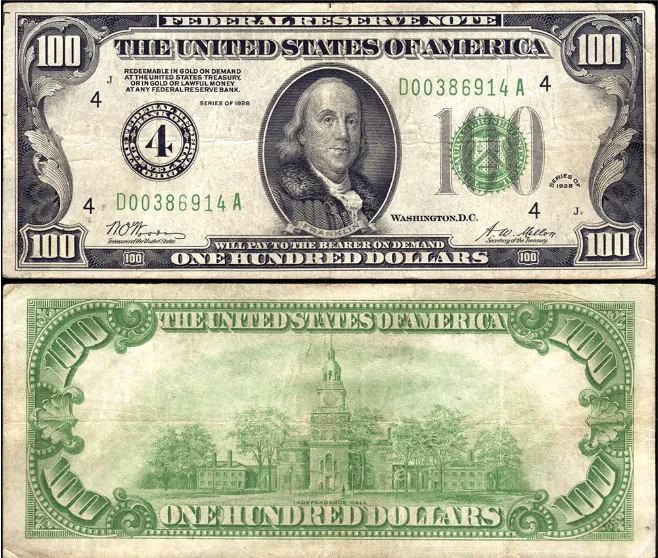
Take the Series 1928 $100 Federal Reserve Note.
These were among the first small-size Federal Reserve Notes, introduced after the government reduced the physical size of American paper money around the end of the 1920s. They show Benjamin Franklin on the front and Independence Hall on the back, creating the basic look that $100 bills would keep for decades.
An ordinary circulated 1928 $100 bill may be worth only a modest amount over its $100 face value. Current collector guides in late 2026 place basic examples starting a little above face value.
But that does not mean every 1928 note is similar.
The Federal Reserve Bank that issued the note matters. Condition matters. Star replacement notes can be scarcer. Certain 1928 notes in high grades can reach into the thousands of dollars.
That is why seeing “1928” should be the beginning of the inspection, not the end.
Series 1934 $100 bills
The 1934 series is another one people commonly find in inherited currency.
Many circulated 1934 $100 Federal Reserve Notes are not extremely rare. Depending on the exact series letter and condition, ordinary examples may carry only a relatively small premium above $100.
The series includes 1934, 1934A, 1934B, 1934C, and 1934D notes. Those letters are important. Some combinations are scarcer than others, and high-grade or star examples can be worth considerably more.
A worn 1934 bill and a crisp 1934D star note may technically both be old $100 bills, but collectors will not necessarily treat them the same way.
Series 1950 $100 bills
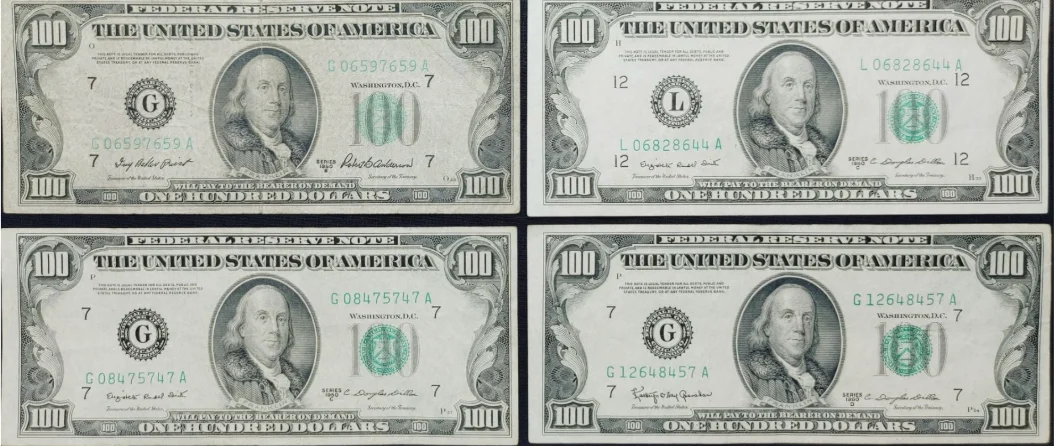
By the 1950 series, ordinary $100 Federal Reserve Notes become even easier to mistake for something extremely valuable simply because they look old.
Most circulated 1950-series notes are fairly common. Current guides show many ordinary examples trading around face value or at relatively small premiums, depending on the exact series and condition.
Again, though, the details matter.
Series 1950, 1950A, 1950B, 1950C, and 1950D all exist. Star notes, unusual serial numbers, and especially well-preserved bills can be worth more than ordinary circulated examples.
1966 red-seal $100 bills
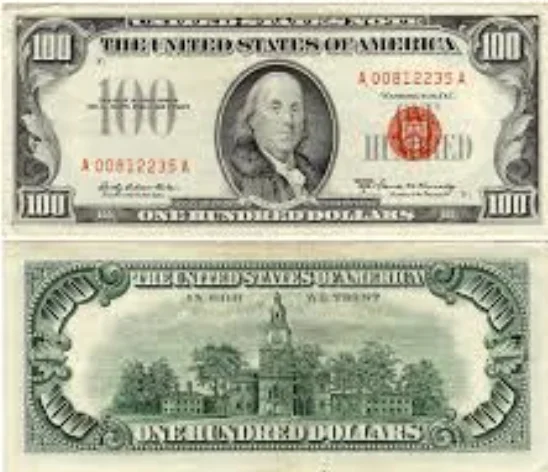
Then there is a $100 bill that looks immediately different: the 1966 red-seal $100.
Most modern $100 bills have green Treasury seals. A Series 1966 $100 instead has a bright red seal and red serial numbers because it is a United States Note, also called a Legal Tender Note, rather than a Federal Reserve Note.
That makes it much easier to recognize.
The Series 1966 and 1966A $100 notes were among the final United States Notes issued. They are collectible even in circulated condition, and better examples can carry substantial premiums.
A 1966 red-seal note’s collector value depends on its grade, condition, and whether it is a star replacement; compare recent sales of matching notes rather than assuming a fixed premium over face value. 1966 $100 reference.
The red seal is therefore worth noticing—but just like with coins, the color alone does not tell you the entire value.
1928 $100 Gold Certificates
Another type of old $100 bill can look even stranger.
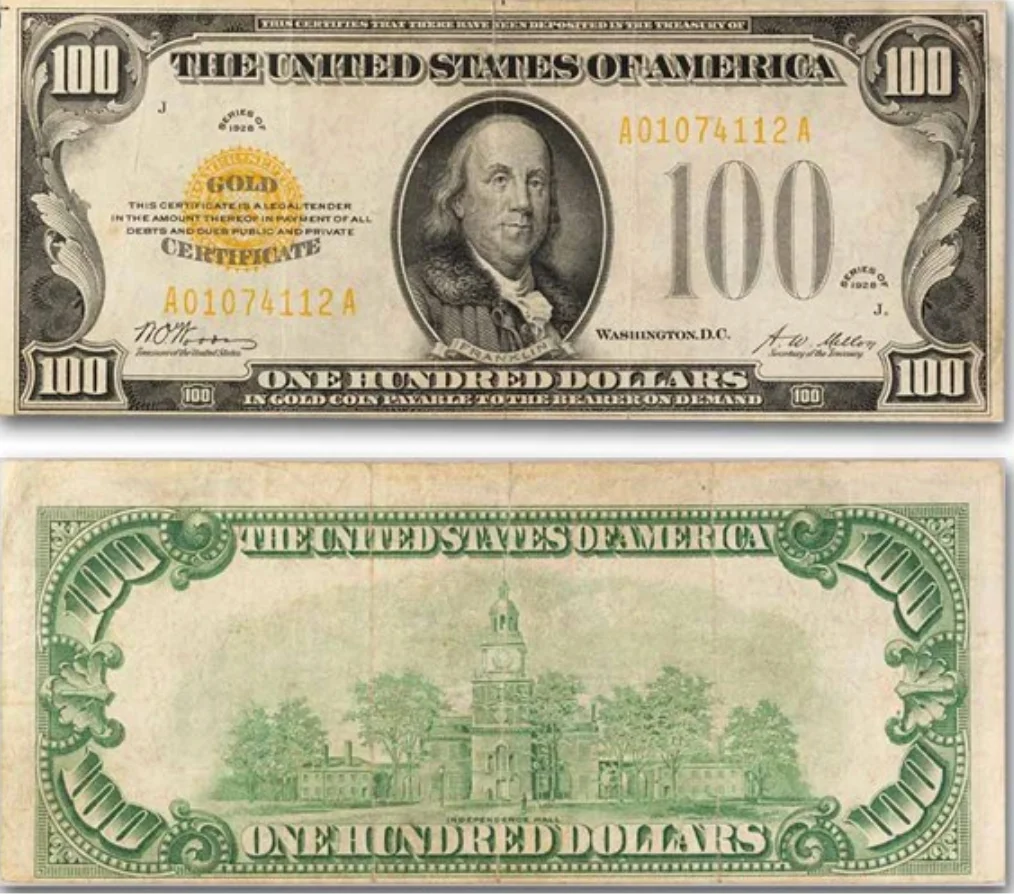
A $100 Gold Certificate is identified by its gold or yellow Treasury seal and distinctive coloring. Gold Certificates were originally part of a system where the notes represented gold held by the U.S. Treasury.
They are no longer redeemable for gold.
Today, their value comes from their history and collector demand.
The small-size 1928 $100 Gold Certificate is especially recognizable because of its yellow seal. These are much scarcer than ordinary Federal Reserve Notes of the same period.
Circulated 1928 $100 Gold Certificates do not have a single typical price: for example, Heritage sold a PMG Choice Fine 15 example with ink marks for $900 on May 21, 2024. While high-grade examples and star notes can rise into the thousands or considerably higher. View the auction result.
So if you find an old $100 bill with a yellow seal, do not assume it is simply another old hundred.
And do not try to spend it before finding out what it is.
Can you still spend old $100 bills?
That brings up an important point: old U.S. money does not simply expire.
Genuine U.S. currency remains legal tender at its full face value regardless of when it was issued. An old $100 Federal Reserve Note can therefore still represent $100 in legal U.S. money.
That does not mean spending it is the best way to use it.
If collectors would pay $150, $500, or $2,000 for a particular bill, using it to buy $100 worth of groceries would obviously leave the collector value behind.
Serial numbers and star notes
The serial number is another detail worth checking before you decide a note is ordinary.
Most serial numbers add no extra value at all.
Some do.
Collectors may pay premiums for very low numbers, repeating patterns, radar numbers that read the same forward and backward, solid numbers containing the same digit repeatedly, and other unusual combinations.
The denomination matters too. Finding an unusual serial number on a $100 bill is different from finding one on a $1 bill because the starting face value is already much higher.
Then there are star notes.
A star note is a replacement note printed when another bill was rejected during production. Instead of simply recreating the original serial number, the replacement carries a star as part of its serial-number system.
Some star notes are common. Others came from much smaller print runs.
On an older $100 bill, that little star is always worth checking before treating the note as ordinary currency.
Condition and protecting your currency
Condition can make just as much difference as the series.
Paper-money collectors care about crispness, corners, centering, folds, stains, tears, writing, and whether the paper still has its original appearance.
A bill that has been folded in a wallet for decades may be worth much less than the exact same series and serial-number type kept flat and untouched.
This is why you should not iron an old bill, wash it, tape tears, erase writing, or try to make it look newer.
Those changes can permanently hurt collector value.
If you find an old $100 bill, start with the obvious clues. Check the series year, seal color, serial number, star, Federal Reserve district, and overall condition. Keep it flat and protected while you figure out exactly what it is.
And remember that $100 is already a meaningful amount of money. There is no reason to rush into selling or spending a note before understanding whether it has additional collector value.
Get an old $100 bill evaluated in Connecticut
For anyone in Connecticut or the surrounding area, Haven Coin & Jewelry at 2285 Whitney Ave in Hamden buys paper currency and offers free, no-obligation evaluations.
Walk-ins are welcome Tuesday, Wednesday, and Friday from 10am–5pm, Thursday from 10am–7pm, and Saturday from 10am–2pm. For a larger currency or estate collection, you can call (203) 717-4921 and arrange an appointment. Haven is a licensed Connecticut precious metals dealer, not a pawn shop.
An old $100 bill is a good reminder that money can develop two different values.
One is printed directly on the paper.
The other comes from everything that happened after it was printed—the series, the seal, the serial number, how many survived, and how carefully one particular note made it through the years.
Sometimes the most interesting thing about an old hundred-dollar bill is that $100 is only the beginning of what it might be worth.
FAQ: Old $100 Bills
Are old $100 bills worth more than $100?
Some are. Many ordinary circulated examples remain worth around face value or a small premium, while scarce series, red or gold seals, star notes, fancy serial numbers, and high-grade bills can be worth much more.
Can you still spend an old $100 bill?
Yes. Genuine old U.S. currency remains legal tender at face value, although a collectible note may be worth more than $100 to a currency collector.
What year $100 bills are worth money?
There is no single year that guarantees value. Notes from series such as 1928, 1934, 1950, and 1966 can all carry premiums depending on the exact type, series letter, seal, serial number, star status, and condition.
How do you tell if an old $100 bill is valuable?
Check the series year, seal color, serial number, star, Federal Reserve district, and condition. Unusual note types such as red-seal United States Notes and yellow-seal Gold Certificates deserve especially close attention.

Written by
Matt Pavia
Founder & Owner, Haven Coin & Jewelry
Matt Pavia is a licensed Connecticut precious metals dealer, ANA member, and GIA-trained appraiser with 8 years of experience buying coins, gold, and jewelry. He founded Haven Coin & Jewelry in Hamden, CT in 2025 and is insured through Lloyd's of London.
About Matt & Haven Coin →Ready to get a professional evaluation? Visit us at 2285 Whitney Ave, Hamden CT or call (203) 717-4921.
Book Free Appointment