
What Are Foreign Gold and Silver Coins?
Foreign gold and silver coins are coins made by countries other than the United States that contain precious metal. This could range from a British gold sovereign, a Mexican 50 peso gold coin, an old Canadian dime, or a silver peso that has been sitting in a drawer since someone’s grandfather brought it home from a trip. Plenty of these coins have found their way into American houses, and we see them in the shop quite regularly.
The good news is that a coin doesn’t need to be American to have some value. If it contains gold or silver, the metal itself has worth, and foreign coins may certainly carry collector value on top of that. The tricky part is that every country used its own compositions, weights, and designs, and those changed over time. So the first step is always working out what the coin is made of, which we’ll walk through below.
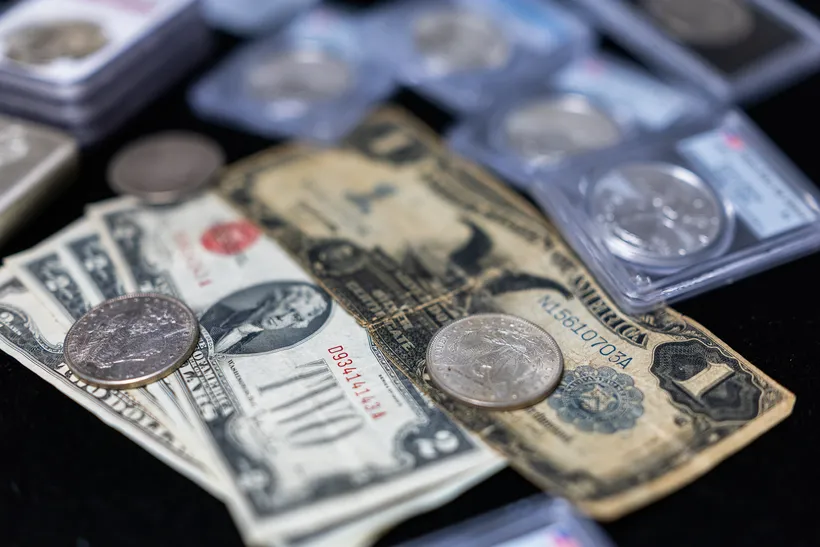
Which Countries Made Silver Coins?
A lot. For much of the 1800s and early 1900s, silver was the standard metal for everyday money, so countries all over the world used it. Some that come up often in the shop are Canada, Great Britain, and Mexico, along with Australia, Switzerland, Germany, France, and many others.
Most of these countries eventually stopped using silver in circulating coins, usually because the metal became too valuable to keep in change. Canada, Britain, and Mexico made the switch at different times, and the silver content varied from one era to the next, so a date alone doesn’t tell you everything. Even within a single country, two coins of the same denomination can contain very different amounts of silver. That’s why it helps to know the country, the date, and the denomination before you figure out what a coin is worth.
How Do You Tell if a Foreign Coin is Silver or Gold?
Start with what’s printed on the coin. Many foreign coins state the metal or purity right on them, and the date often tells you the era. Gold-colored base metals and plating can resemble gold, so color alone cannot identify a gold coin. Silver coins tend to look bright when clean or develop gray or dark toning over time.
For anything you’re unsure about, a few simple checks help. Pure silver and gold are not strongly attracted to a magnet, but a magnetic response does not rule out precious-metal plating or a mixed-metal construction, and a nonmagnetic coin is not proof of gold or silver. Weight and size matter too, since you can compare a coin to published specs for its type. Looking at the edge can help, because many silver coins have a uniform edge, while clad coins show layers. These checks are useful, but they’re not conclusive, and fakes exist. When a coin is worth real money, we test it in person, which is far more reliable than guessing from photos.
How Much Silver is in Canadian Silver Coins?
Canadian dimes, quarters, and half dollars dated 1920 through 1966 are generally 80% silver; the circulating silver dollars introduced in 1935 also used that standard. Earlier Canadian silver issues generally used .925 silver, while cents and later five-cent pieces follow different rules. For the 80% coins, the silver content is about 0.06 troy ounces in a dime, 0.15 in a quarter, 0.30 in a half dollar, and 0.60 in a silver dollar. A handy rule is that $1 in face value of those 80% silver denominations holds roughly 0.6 troy ounces of silver.
1967 and 1968 are a transition. The 1967 dimes and quarters can be 80% or 50% silver, while the half dollar and dollar remained 80% silver that year. In 1968, dimes and quarters were made in both 50% silver and nickel versions; the half dollar and dollar had switched to nickel. Regular Canadian circulation issues after 1968 contain no silver, although later collector and bullion coins can. To estimate metal value, multiply the coin’s fine-silver content by the live silver price at Kitco’s silver price chart. This is a reference value, not a guaranteed dealer offer, and collector premiums may add to it.
How Much Silver is in Mexican Silver Coins?
It depends on the coin. A common example is the silver peso with the “cap and rays” design struck from 1920 to 1945, which is .720 fine silver and contains about 0.386 troy ounces. Older Mexican silver pesos from the 1800s and early 1900s can have different purities and more silver, and later Mexican coins have less, with the silver content eventually dropping and then disappearing.
Because Mexican silver coins span so many types, we’d suggest looking up the specific coin by its date, denomination, and design before assuming a number. Mexico also makes modern bullion silver coins, such as the Libertad, which are a different category from old circulation pieces. As always, the estimated silver content value is the coin’s silver content multiplied by the live price at Kitco’s silver price chart, and condition and date may raise the value.
How Much Silver is in British Silver Coins?
For many familiar British circulating silver denominations, three periods matter. Through 1919, they were sterling silver (.925 fine). In 1920 the half crown, florin, and shilling were debased to .500 fine, meaning 50% silver, and that composition continued through 1946. From 1947 on, the regular circulating denominations were switched to cupro-nickel and contain no silver at all.
That makes the date especially important for British coins. A 1919 or earlier piece has more silver than a 1940 one, and the ordinary circulating counterparts from 1947 onward are base metal. Maundy and later silver collector issues are exceptions, so the specific issue matters. Because silver content changes by denomination and weight, we recommend checking a reference for the exact coin, then multiplying its silver content by the live price at Kitco’s silver price chart.
What is a British Gold Sovereign Worth?
A full British gold sovereign is a small coin with big value. It weighs about 7.98 grams, is 22 karat (.9167 fine), and contains about 0.2354 troy ounces of pure gold. The half sovereign holds about 0.1177 troy ounces. Modern sovereigns date back to 1817, and the coin is still made today.
To find the gold value, multiply 0.2354 by the live gold price at Kitco’s gold price chart. That’s the baseline, and most sovereigns trade at that value plus a premium because they’re a popular, well-known gold coin. Some dates, mints, and conditions are scarcer than others and can be worth more than the basic gold content. A date that’s rare or a coin in exceptional condition is worth having evaluated in person.
What is a Mexican Gold Peso Worth?
The historic Mexican gold peso denominations listed here are .900 fine gold; other Mexican gold issues can have different fineness. The best known is the 50 peso Centenario, which contains about 1.2057 troy ounces of gold, followed by the 20 peso (0.4823), the 10 peso (0.2411), and the 5 peso (0.1206). Centenario production began in 1921, stopped in 1931, and resumed in 1943; many later official restrikes carry the 1947 date and the same gold content.
The value starts with the gold math: multiply the coin’s gold content by the live price. Retail prices may include a premium over gold value, but dealer buy offers depend on demand, condition, authenticity, and transaction costs. Older original-date coins and ones in exceptional condition can be worth more, but for most people the gold content is the main driver. Because these coins are copied, we’d have any suspected piece tested.
How Are Foreign Coins Valued?
For gold and silver coins, the process is the same every time. Start by identifying the coin: country, denomination, date, and metal. Next, find its precious metal content, which is the weight multiplied by the purity. Express that fine-metal weight in troy ounces, then multiply by the live spot price per troy ounce, and you have the coin’s metal value.
From there, you consider whether the coin carries a premium. Some are valued purely on the metal inside, while others have extra value because of rarity, date, or condition. Because of that, the same type of coin can be worth very different amounts. A common-date sovereign and a scarce one are both gold, but they’re not priced the same. We’d tell you to start with the metal, then check whether anything about the coin sets it apart.
Do Foreign Coins Carry a Collector Premium?
Sometimes, but not as often as people hope. Most foreign gold and silver coins are valued mainly on their metal content, and a collector premium appears only when a coin is scarce, in outstanding condition, or from a date and mint that collectors are chasing. Some of the better known gold coins, like sovereigns and Centenarios, carry a modest premium simply because they’re popular.
Real rarities do exist. Canada’s 1921 50-cent piece, for example, is a famous key date. But those are the exception, and a worn, common-date coin is generally worth its metal plus a little. It also depends on demand: a coin that’s popular with collectors in its home country may be less known here. If you think you have something special, an evaluation in person is the best way to find out.
Why Do Some Buyers Refuse Foreign Coins?
It’s usually a matter of knowledge and risk. Foreign coins take more work to identify, since there are thousands of types with different compositions, and a buyer who doesn’t know the series well can’t be sure what they’re looking at. Counterfeits and lookalikes add to the risk, and some coins that appear to be silver or gold are actually base metal.
There’s also the matter of demand. Some buyers focus only on U.S. coins or bullion and don’t want the extra work. That’s why we’d suggest asking before you make the trip. At Haven Coin & Jewelry, we do buy foreign coins, and we’ll look at them one at a time. If a buyer tells you they won’t touch foreign coins, it doesn’t mean yours are worthless. It may only mean that the buyer doesn’t handle them.

How Do You Sell Foreign Gold and Silver Coins?
Start by sorting your coins by country and type, and set aside anything that looks like gold or is dated before the mid-1960s, since those are the likeliest to contain precious metal. Write down what you can read on each coin, and don’t clean them. Cleaning can hurt value, and it also makes identification harder.
We always recommend getting more than one opinion before selling. If you’re in or around Hamden, Connecticut, stop by Haven Coin & Jewelry for a free, no-obligation evaluation. No appointment necessary, just walk in during business hours (Tuesday–Friday 10am–5pm and Saturday 10am–2pm), or give us a call to schedule a time if you’re bringing in a larger collection. We’re a licensed Connecticut precious metals dealer, not a pawn shop, and we’ll go through your coins right in front of you, price them individually against live market prices, and give you a written offer to keep. You can reach us at (203) 717-4921, or find us at 2285 Whitney Ave, Hamden, CT.
FAQ: Foreign Gold and Silver Coins
Are foreign coins worth money?
Many are. Gold or silver content gives a coin a metal-value reference, and some coins carry collector premiums, but the amount a buyer offers can be below melt value.
How can you tell if a foreign coin is silver?
Check the date and country, since many coins from before the mid-1960s are silver. Then compare the weight and size to published specs, and have it tested if it’s valuable.
What year did Canada stop making silver coins?
The last regular silver circulation issues were 50% silver dimes and quarters in 1968. Those denominations also have nickel versions that year. Half dollars and dollars last contained circulation silver in 1967; later collector and bullion issues can still contain silver.
Where can I sell foreign coins?
Local coin and bullion dealers who handle foreign coins are the best bet. Ask first, and get more than one opinion.

Written by
Matt Pavia
Matt Pavia is a licensed Connecticut precious metals dealer, ANA member, and GIA-trained appraiser with 8 years of experience buying coins, gold, and jewelry. He founded Haven Coin & Jewelry in Hamden, CT in 2025 and is insured through Lloyd's of London.
About Matt & Haven CoinVisit Haven in Hamden
Know what you have.
Understand what it’s worth.
Ready to get a professional evaluation? Visit us at 2285 Whitney Ave, Hamden CT or call (203) 717-4921.
Book Free Appointment Hours & directions