
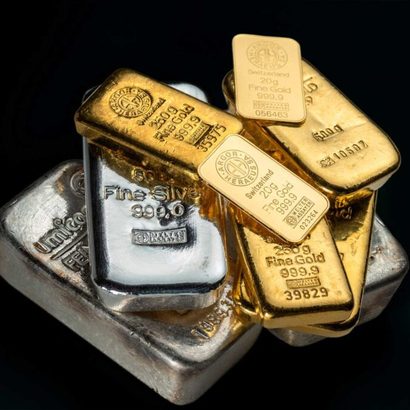
Bullion — gold bars, silver bars, and bullion coins like American Eagles and Maple Leafs — is the most straightforward category of precious metals to sell. The pricing is transparent, the math is simple, and a licensed dealer can make you an offer in minutes. But there are still things worth knowing before you walk in. This guide covers how bullion is priced, what affects your offer, and what to expect when selling gold or silver bullion in Connecticut. For a full list of everything we purchase, see our what we buy page.
What Counts as Bullion
Bullion refers to precious metals sold primarily for their metal content rather than their numismatic or collector value. Common bullion items include:
Gold Bullion
- American Gold Eagles (1 oz, 1/2 oz, 1/4 oz, 1/10 oz)
- Canadian Gold Maple Leafs
- South African Krugerrands
- Austrian Gold Philharmonics
- Gold bars and rounds in various weights
- Pre-1933 U.S. gold coins traded at bullion value
Silver Bullion
- American Silver Eagles
- Canadian Silver Maple Leafs
- Silver bars (1 oz, 5 oz, 10 oz, 100 oz)
- Silver rounds from private mints
- 90% silver U.S. coins (commonly called "junk silver")
Platinum and Palladium
- American Platinum Eagles
- Platinum and palladium bars
- Catalytic converter scrap (evaluated separately)
How Bullion Is Priced
Bullion pricing is the most transparent in the precious metals world because it is directly tied to live spot prices. Here is exactly how it works:
Spot price is the current market price for one troy ounce of the metal — gold, silver, platinum, or palladium. It updates continuously during market hours and is publicly available on any financial website.
Your offer is based on live spot price. Our offers are calculated in front of you from the live spot price, your items' exact weight, and their tested purity — we show you the math on every offer, and evaluations are always free.
Premium items — certain coins like American Silver Eagles often trade at a premium above spot due to collector demand. A knowledgeable dealer will account for this when making your offer.
At Haven Coin & Jewelry we use live spot prices updated in real time and show you exactly how we calculated your offer before you make any decision. Our free appraisals include a full breakdown of the spot calculation on every piece.
What Affects Your Bullion Offer
Even within bullion, a few factors influence what you receive:
Condition
Standard bullion coins and bars in average condition receive full offers. Heavily damaged, scratched, or cleaned pieces may receive slightly lower offers as they are harder to resell at premium. Coins in original mint packaging or sealed tubes receive the best offers.
Quantity
Larger quantities of bullion often receive better offers. If you are selling a significant amount — 20 or more ounces of silver, or multiple gold coins — mention this when booking your appointment.
Authentication
Reputable dealers test all bullion before making an offer. Common tests include weight verification, dimension checks, and electronic XRF testing. This protects you as much as the dealer — counterfeiting of bullion has increased and professional testing confirms you are being paid for genuine metal.
Junk Silver — What It Is and What It's Worth
One of the most commonly inherited and misunderstood forms of bullion is junk silver — U.S. coins minted before 1965 that contain 90 percent silver. This includes Morgan dollars, Peace dollars, Walking Liberty halves, Franklin halves, Mercury dimes, and Roosevelt dimes minted before 1965.
Despite the name, junk silver is not worthless. It is simply silver traded at or near melt value rather than for collector reasons. A full bag of 90 percent silver coins — face value $1,000 — contains approximately 715 troy ounces of silver. With silver around $64 per ounce as of September 2026, that is over $45,000 in metal value. Prices move every trading day — you can check the live number anytime with our free calculator at meltcalculator.com.
If you have a collection of old U.S. coins that appear to be common circulated examples, do not assume they are worthless. Bring them in — many collections contain far more value than their owners realize. If the coins came from an estate, our guide on inherited coin collections covers the full process from discovery to sale.
Selling Bullion vs. Selling Coins — Know the Difference
Not everything that looks like bullion should be sold as bullion. Some coins that trade near spot price are actually worth significantly more to collectors.
Key dates, error coins, and high-grade examples within bullion series — like a 1995-W American Silver Eagle proof or a rare date Morgan dollar — can be worth multiples of their melt value. A dealer who only pays spot for everything is not serving your best interests.
At Haven Coin & Jewelry we evaluate every coin individually before defaulting to spot price. If something has numismatic value above its melt value, we tell you. When you're ready to sell coins in Connecticut, this distinction is exactly why working with a dedicated numismatic dealer matters.
Where to Sell Bullion in Connecticut
Haven Coin & Jewelry is located at 2285 Whitney Ave in Hamden — conveniently accessible from New Haven, North Haven, Cheshire, Woodbridge, Orange, Milford, Wallingford, and all of New Haven County. We buy gold bullion, silver bullion, platinum, palladium, and junk silver at competitive prices based on live spot rates.
We are fully licensed and insured, test all bullion in front of you, and make transparent offers with no pressure to sell. If you are searching for somewhere to sell gold or silver near me in Connecticut, we are here.
Selling bullion in Connecticut is straightforward when you work with a licensed, transparent dealer who uses live spot prices and shows you the math. Whether you have a single gold coin or a full collection of silver bars, Haven Coin & Jewelry in Hamden is ready to give you a free, no-obligation evaluation and a competitive same-day offer.
Bullion Types at a Glance
| Bullion Type | Purity | Typical Offer vs. Spot | Notes |
|---|---|---|---|
| Gold bars & rounds | .999 | 95–97% | Assay card helps |
| American Gold Eagles | .9167 (22K) | Priced from live spot — the math shown on every offer | High liquidity |
| Silver bars & rounds | .999 | Priced from live spot — the math shown on every offer | Sealed tubes best |
| American Silver Eagles | .999 | Spot + small premium | Collector demand adds value |
| Junk silver (90%) | 90% | Priced from live spot — the math shown on every offer | Check for key dates first |
Frequently Asked Questions
Do I need original packaging to sell bullion?
No — original packaging is a plus but never required. Coins and bars are tested and valued on their metal content regardless of packaging. Sealed tubes and assay cards may support a slightly better offer but are not mandatory.
How do dealers test bullion to make sure it's genuine?
Standard tests include weight verification against known specifications, dimensional checks with precision calipers, and XRF (X-ray fluorescence) electronic testing that reads metal composition without damaging the piece. All testing should be done in front of you.
Is junk silver worth selling even in small amounts?
Yes. Even a handful of pre-1965 dimes, quarters, or half dollars has real silver value. There is no minimum quantity required for an evaluation at Haven Coin & Jewelry.
What's the difference between a bullion coin and a proof coin?
Bullion coins are produced for investors and trade primarily on metal content. Proof coins are specially minted with mirror-like surfaces for collectors and often carry premiums above spot. Some proof bullion coins — like certain Silver Eagle proofs — are worth significantly more than their melt value.

Written by
Matt Pavia
Founder & Owner, Haven Coin & Jewelry
Matt Pavia is a licensed Connecticut precious metals dealer, ANA member, and GIA-trained appraiser with 8 years of experience buying coins, gold, and jewelry. He founded Haven Coin & Jewelry in Hamden, CT in 2025 and is insured through Lloyd's of London.
About Matt & Haven Coin →Ready to get a professional evaluation? Visit us at 2285 Whitney Ave, Hamden CT or call (203) 717-4921.
Book Free Appointment